
NPS vs Mutual Funds for Retirement: Which Wins in 2026?
NPS vs mutual funds for retirement: returns, 80CCD tax benefits, lock-in, annuity rules and withdrawals, with a verdict by investor profile.


Disclaimer: This article is for educational purposes only and does not constitute financial advice. The author is not a SEBI-registered advisor or certified financial planner. Please consult a qualified professional before making any investment or tax decisions.
This article is for educational purposes only and does not constitute financial advice. Tax laws and NPS regulations change; consult a SEBI-registered investment adviser or chartered accountant for personalised guidance.
India's National Pension System crossed ₹13.5 lakh crore in assets under management by March 2026, with subscriber count exceeding 1.5 crore for the private sector (NPS Corporate and All Citizens model). Growth is partly driven by the additional ₹50,000 deduction under Section 80CCD(1B) — a benefit mutual fund investments cannot match. Yet most wealth estimates suggest that a well-structured mutual fund SIP outperforms NPS on post-tax corpus at most income levels.
Both statements can be true. Here is the complete comparison. If you want EPF and PPF folded into the picture too, see our three-way EPF vs NPS vs PPF comparison.
Side-by-side: the key dimensions
| Dimension | NPS (Tier I) | Equity Mutual Funds |
|---|---|---|
| Primary tax benefit | 80CCD(1): up to 10% of salary (within ₹1.5L 80C limit) + 80CCD(1B): additional ₹50,000 | 80C via ELSS only (₹1.5L cap); no ELSS-specific benefit beyond ₹1.5L |
| Employer contribution | Up to 10% of salary deductible for employer (14% for government employees) — excluded from employee income | Not applicable |
| Lock-in | Until age 60 (partial withdrawal allowed after 3 years for specific purposes) | ELSS: 3 years; all other MFs: no lock-in |
| Exit rule | At 60: minimum 40% must buy annuity; remaining 60% tax-free lump sum. Early exit: 80% to annuity, 20% lump sum | Full redemption any time (after lock-in if ELSS) |
| Annuity obligation | Mandatory 40% annuity purchase at retirement | None |
| Returns | Auto Choice (LC75): ~10–12% historical; Active Choice: up to 75% equity, NPS E-class ~11–13% CAGR historically | Nifty 50 index: ~13–14% 15-year CAGR; active large-cap: ~12–15% |
| LTCG tax on equity gains | Nil on the 60% lump sum; annuity income taxed as per slab | 12.5% on gains above ₹1.25L/year |
| Expense ratio | 0.09% (one of lowest globally, capped by PFRDA) | Index funds: 0.10–0.20%; active: 0.5–1.5% |
| Flexibility | Fund manager change allowed; E/C/G allocation adjustable twice yearly | Fund switch any time (with exit load considerations) |
| Partial withdrawals | Allowed after 3 years for education, marriage, housing, medical (up to 25% of own contributions, max 3 times) | No restrictions beyond lock-in |
Use the Stax NPS Calculator and Mutual Fund Returns Calculator to model both scenarios with your own numbers.
The tax benefit that changes the calculation
The ₹50,000 deduction under Section 80CCD(1B) is the defining feature of NPS. It is the only investment with a dedicated tax deduction beyond the ₹1.5 lakh Section 80C limit.
For a taxpayer in the 30% slab (old regime) investing ₹50,000 extra annually:
- Tax saved: ₹50,000 × 31.2% (including 4% cess) = ₹15,600 per year
Over 25 years, ₹15,600 annually invested at 11% compounds to approximately ₹17.4 lakh in additional corpus — purely from tax savings reinvested. This is NPS's structural advantage over mutual funds.
For new-regime taxpayers, the 80CCD(1B) benefit does not apply (the new regime disallows most deductions). However, employer contributions to NPS remain deductible for the employer even under the new regime, making it relevant for salary structuring discussions with HR.
The corpus comparison over 25 years
Assumptions: ₹10,000/month invested, 25-year horizon, retirement at 60. For the broader question of what a monthly SIP of this size builds toward, see our guide to building a ₹1 crore SIP corpus.
| Scenario | Assumed Return | Pre-tax Corpus | Effective Post-tax Corpus |
|---|---|---|---|
| NPS Active (75% equity) | 11% p.a. | ₹1.26 cr | ~₹1.01 cr* |
| NPS + tax savings reinvested | 11% p.a. | ₹1.44 cr | ~₹1.15 cr* |
| Nifty 50 index fund SIP | 13% p.a. | ₹1.89 cr | ~₹1.63 cr† |
| Active flexi-cap MF (optimistic) | 14% p.a. | ₹2.26 cr | ~₹1.95 cr† |
*NPS post-tax: 40% corpus buys annuity (annuity income taxed as salary income at slab rate; not modelled in full here); 60% lump sum is tax-free. †MF post-tax: LTCG at 12.5% on total gains above ₹1.25L each year at redemption; estimated effective rate ~10–15% of total corpus depending on withdrawal pattern. See our full capital gains tax on mutual funds guide for how this is worked out across fund types.
At 13–14% equity returns, mutual funds build a larger post-tax corpus even after LTCG. NPS narrows the gap significantly via the 80CCD(1B) tax saving — especially for 30% bracket taxpayers. NPS wins only if equity returns underperform expectations (below ~10% CAGR long-term) or if the 30% bracket tax saving is maximised and consistently reinvested.
The annuity problem
The mandatory 40% annuity purchase is NPS's most significant structural disadvantage. Annuity rates in India currently range from approximately 5.5% to 6.5% per annum depending on the type and insurance company. This is below the current fixed deposit rate of 7.0–7.5% and significantly below inflation-adjusted equity returns.
A ₹50 lakh annuity purchase at 6% provides ₹3 lakh/year (₹25,000/month). The same ₹50 lakh in a Systematic Withdrawal Plan (SWP) at 8% withdrawal rate from a balanced advantage fund historically sustains withdrawals for 20+ years. The annuity income is also fully taxable as income at the applicable slab rate.
The annuity requirement does provide longevity protection (payments continue for life regardless of corpus depletion), which is genuinely valuable for risk-averse retirees with no other pension income.
Who should choose NPS
Choose NPS if:
- You are a salaried employee in the old tax regime in the 30% bracket and want the 80CCD(1B) ₹50,000 extra deduction — the tax saving is real money
- Your employer offers NPS with employer contribution (effectively free money added to your corpus)
- You are a government employee (NPS Tier I is mandatory; Tier II offers additional flexibility)
- You want the world's lowest-cost equity investment vehicle (0.09% TER) and are disciplined enough to not need liquidity before 60
- You are comfortable with the 40% annuity obligation and have other liquid assets for retirement spending
Choose mutual funds if:
- You are in the new tax regime (80CCD(1B) not available)
- You may need access to funds before age 60 (job change, health emergency, early retirement)
- You want full flexibility over withdrawal at retirement (no annuity mandate)
- You believe long-term equity returns will be 13%+ and want maximum compounding
- Your retirement corpus will be supplemented by EPF, gratuity (estimate yours with the Gratuity Calculator), or property income — meaning you don't need the longevity insurance the annuity provides
Consider both: Split your retirement investment. Use NPS for the ₹50,000 80CCD(1B) deduction (if old regime, 30% slab) plus any employer NPS contribution. Direct the remaining surplus into equity index funds. This captures the tax benefit while keeping the bulk of the corpus in more flexible, potentially higher-returning instruments.
By Grishma, personal finance writer at Stax Tools. Return estimates are historical averages and not a guarantee of future performance. NPS AUM figure sourced from PFRDA.
Sources & methodology
- PFRDA Statistics Handbook — pfrda.org.in (NPS AUM and subscriber data)
- PFRDA Master Circular on NPS Investment Guidelines — NPS E-class historical returns
- Value Research — Best NPS fund managers, 10-year performance review — NPS pension fund category returns
- Income Tax Department — Deductions under Section 80CCD — Finance Act 2024 provisions
Grishma
Finance Content Writer
Grishma writes about personal finance, investing, and tax planning for Indian readers — translating complex regulatory changes into clear, actionable guidance.
More by Grishma →Tools mentioned in this article
- NPS Calculator
Calculate NPS corpus, 60% lump sum, and estimated monthly pension at retirement.
- Mutual Fund Returns Calculator
Estimate mutual fund returns for both SIP (monthly) and lumpsum (one-time) modes. See maturity value, total invested, and gain.
- Gratuity Calculator
Calculate gratuity as per Payment of Gratuity Act 1972 with eligibility check.
Related reading
 EPF vs NPS vs PPF: Retirement Comparison for SalariedEPF vs NPS vs PPF compared on contributions, interest rates, lock-in, withdrawals and tax at maturity, and how to combine all three for retirement.6 min read
 ELSS vs PPF: Which 80C Option Wins in FY2026-27?With PPF at 7.1% and rates falling, the ELSS vs PPF choice has shifted. Compare 10-year returns, lock-in and tax treatment for your ₹1.5 lakh 80C.6 min read
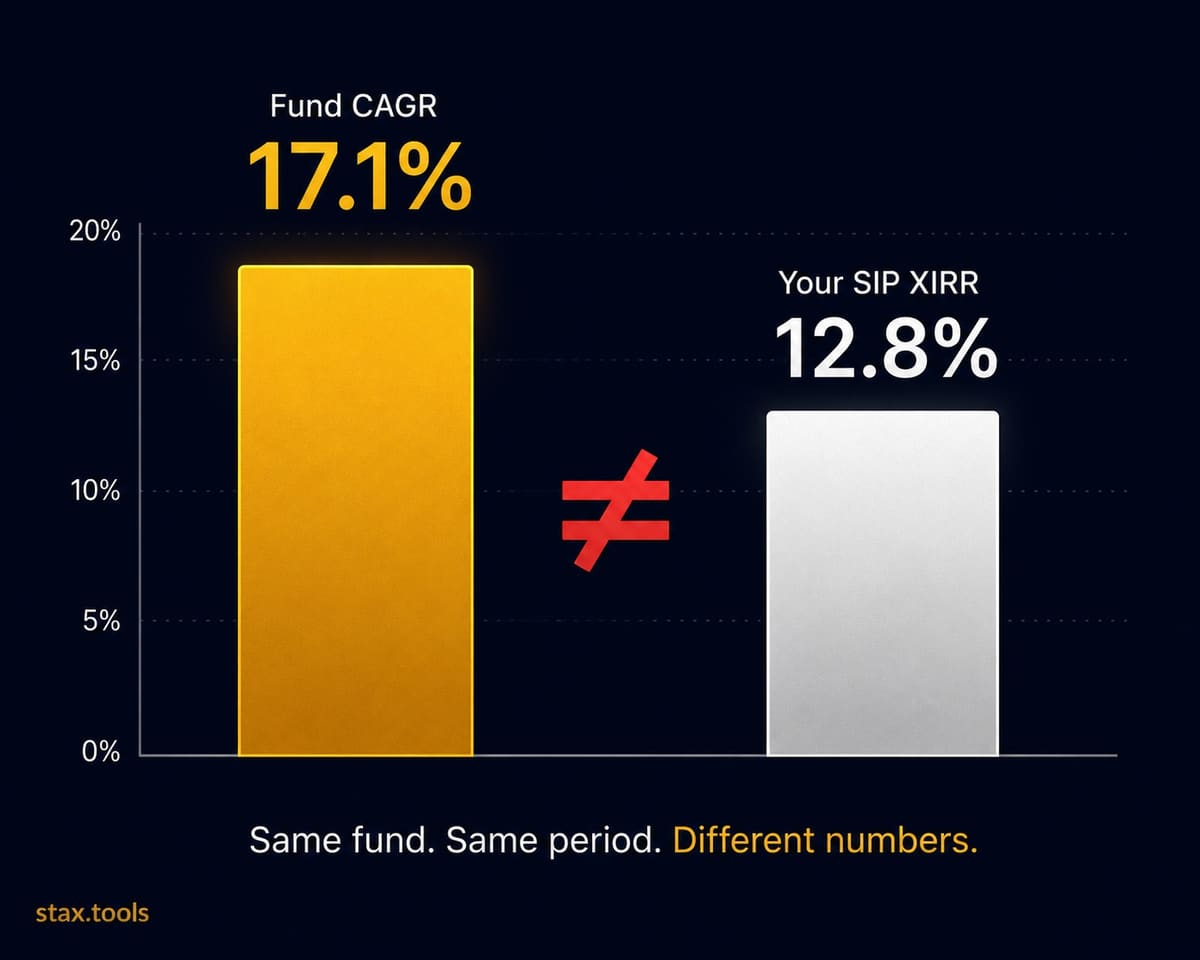 Your SIP Return Is Not CAGR: XIRR ExplainedXIRR vs CAGR: investors confuse fund CAGR with personal XIRR, and for SIPs the gap can be 3–5 percentage points. The math and a worked example.7 min read
 HDFC AMC Cyber Incident: Are Your Mutual Funds Safe?HDFC AMC disclosed a cybersecurity incident. What happened, whether your units are at risk, what data AMCs hold about you and the steps to take now.11 min read
Found this useful?
Browse 300+ free privacy-first tools — no login, no uploads, instant results.