
Old vs New Tax Regime: Which Saves More in FY2026-27?
Old vs new tax regime: the new regime is the default in India but not always better. Use this break-even analysis to see which saves you more.

Disclaimer: This article is for educational purposes only and does not constitute financial advice. The author is not a SEBI-registered advisor or certified financial planner. Please consult a qualified professional before making any investment or tax decisions.
Since the Union Budget 2023-24, the new tax regime has been the default for salaried employees in India. If you don't submit a declaration to your employer, your TDS is computed under the new regime automatically. But "default" does not mean "better for everyone." For many taxpayers with home loans, HRA, and active tax-saving investments, the old regime still produces a lower tax outgo.
The question is specific to your numbers: your salary, your deductions, your investments. This guide walks through the slab structure for both regimes, the key deductions you give up under the new regime, and the break-even analysis that tells you which one to choose for FY2026-27.
One change of name matters here. The Income-tax Act, 2025 replaced the 1961 Act from 1 April 2026, so FY2026-27 is called "tax year 2026-27" and the sections have new numbers: the new regime is Section 202 (it was 115BAC), the rebate is Section 156 (it was 87A), 80C is Section 123, 80D is Section 126 and the standard deduction is Section 19. The Finance Act 2026 left the individual rates unchanged, so the numbers below are the same as FY2025-26. You will still see the old section numbers in most articles and in many payslips.
The slab rates side by side
New tax regime (FY2026-27)
Section 202 of the Income-tax Act, 2025 sets these default rates for tax year 2026-27. They were introduced by Budget 2025-26 and the Finance Act, 2026 kept them unchanged:
| Income slab | Tax rate |
|---|---|
| Up to ₹4,00,000 | Nil |
| ₹4,00,001 – ₹8,00,000 | 5% |
| ₹8,00,001 – ₹12,00,000 | 10% |
| ₹12,00,001 – ₹16,00,000 | 15% |
| ₹16,00,001 – ₹20,00,000 | 20% |
| ₹20,00,001 – ₹24,00,000 | 25% |
| Above ₹24,00,000 | 30% |
Under the new regime, a resident individual with total income up to ₹12 lakh pays no tax: Section 156(2) of the 2025 Act (Section 87A under the old Act) gives a rebate of the tax payable or ₹60,000, whichever is less. Just above ₹12 lakh, marginal relief limits the tax to the amount by which income exceeds ₹12 lakh. The standard deduction of ₹75,000 (Section 19) is also available, so a salary up to ₹12.75 lakh is effectively nil-tax for salaried individuals. Tax is then increased by 4% Health and Education Cess, and by surcharge above ₹50 lakh of total income.
Old tax regime (FY2026-27)
| Income slab | Tax rate |
|---|---|
| Up to ₹2,50,000 | Nil |
| ₹2,50,001 – ₹5,00,000 | 5% |
| ₹5,00,001 – ₹10,00,000 | 20% |
| Above ₹10,00,000 | 30% |
These rates apply if you opt out of the default under Section 202(4). The old-regime rebate (Section 156(1)) is the tax payable or ₹12,500, whichever is less, and applies only when total income after deductions is ₹5 lakh or less. Standard deduction is ₹50,000. Individuals aged 60 to 79 have a ₹3 lakh exemption limit and those aged 80 and over ₹5 lakh.
The old regime's slabs look worse on paper, but the regime allows a wide set of deductions that reduce taxable income significantly before the slabs even apply.
What you give up in the new regime
The new regime's lower rates come at a cost: most of the deductions and exemptions that reduce taxable income in the old regime are unavailable. Key items you cannot claim:
| Deduction / Exemption | Old regime | New regime |
|---|---|---|
| Standard deduction (salaried) | ₹50,000 | ₹75,000 ✅ |
| 80C (PPF, ELSS, LIC, home loan principal), now Section 123 | Up to ₹1,50,000 | ❌ Not available |
| 80D (health insurance premium), now Section 126 | Up to ₹25,000 for you and family, plus ₹25,000 for parents (₹50,000 each where the person is a senior citizen) | ❌ Not available |
| HRA exemption | Based on actual rent paid | ❌ Not available |
| Home loan interest on a self-occupied home (24(b), now Section 22(1)(b)) | Up to ₹2,00,000 | ❌ Not available |
| LTA (Leave Travel Allowance) | Exemption for actual travel | ❌ Not available |
| 80CCD(1B) NPS additional contribution, now Section 124(3) | Up to ₹50,000 | ❌ Not available |
| Professional tax deduction | Actual amount paid | ❌ Not available |
The new regime does allow a few deductions: employer NPS contribution (80CCD(2), now Section 124(1)–(2)), the standard deduction of ₹75,000, and some allowances. But the big-ticket items — 80C, HRA, home loan interest on a self-occupied home — are off the table.
The break-even: when is the old regime better?
The old regime is better when your deductions are large enough to offset the disadvantage of its higher marginal rates. The table shows the deductions needed on top of the standard deduction, for a salaried person, for the old regime's total tax (including 4% cess) to match the new regime's. It is computed from the same slabs, rebate and cess that the calculator uses.
| Annual salary | Deductions needed beyond the standard deduction for the old regime to win |
|---|---|
| ₹8 lakh | ₹2.5 lakh or more |
| ₹10 lakh | ₹4.5 lakh or more |
| ₹12 lakh | ₹6.5 lakh or more |
| ₹15 lakh | ₹5.44 lakh or more |
| ₹20 lakh | ₹7.08 lakh or more |
| ₹25 lakh | ₹8 lakh or more |
| ₹30 lakh | ₹8 lakh or more |
The hurdle peaks around ₹12 lakh because the new regime charges nothing there, so the old regime would have to bring tax to zero as well. It falls at ₹15 lakh, where the new regime starts charging tax, and then rises to a ceiling of about ₹8 lakh. For comparison, a typical homeowner can claim ₹1.5 lakh under 80C, up to ₹2 lakh of home loan interest, ₹50,000 under 80CCD(1B) and ₹25,000–₹50,000 under 80D, plus whatever HRA exemption applies. Only the total of your deductions matters, not the mix, because every deduction simply reduces taxable income.
To find your exact number, use the Stax Income Tax Calculator — enter your gross salary and deduction details under both regimes to see the actual tax difference.
Real examples at common salary levels
Example 1: ₹10 lakh gross salary, moderate deductions
| Scenario | Old regime | New regime |
|---|---|---|
| Gross salary | ₹10,00,000 | ₹10,00,000 |
| Standard deduction | ₹50,000 | ₹75,000 |
| 80C (full) | ₹1,50,000 | — |
| 80D (health insurance) | ₹25,000 | — |
| Taxable income | ₹7,75,000 | ₹9,25,000 |
| Tax on slabs | ₹67,500 | ₹32,500 |
| Tax after rebate | ₹67,500 | ₹0 |
| Cess (4%) | ₹2,700 | ₹0 |
| Total tax | ₹70,200 | ₹0 |
| Verdict | New regime saves ₹70,200 |
At ₹10 lakh with only the standard deduction, 80C and 80D, the new regime wins by a wide margin, because the rebate removes all of its tax.
Example 2: ₹12 lakh gross salary, home loan + HRA + investments
| Scenario | Old regime | New regime |
|---|---|---|
| Gross salary | ₹12,00,000 | ₹12,00,000 |
| Standard deduction | ₹50,000 | ₹75,000 |
| HRA exemption | ₹96,000 (₹8,000/month) | — |
| Home loan interest (Section 22) | ₹1,50,000 | — |
| 80C (full) | ₹1,50,000 | — |
| 80D | ₹25,000 | — |
| Total deductions | ₹4,71,000 | ₹75,000 |
| Taxable income | ₹7,29,000 | ₹11,25,000 |
| Tax after rebate | ₹58,300 | ₹0 |
| Cess (4%) | ₹2,332 | ₹0 |
| Total tax | ₹60,632 | ₹0 |
| Verdict | New regime saves ₹60,632 |
Even with a home loan and HRA, the new regime is better at ₹12 lakh, because its tax is nil. The deductions here (₹4.21 lakh beyond the standard deduction) are well short of the ₹6.5 lakh break-even in the table above.
Example 3: ₹20 lakh gross salary, maximum deductions
| Scenario | Old regime | New regime |
|---|---|---|
| Gross salary | ₹20,00,000 | ₹20,00,000 |
| Standard deduction | ₹50,000 | ₹75,000 |
| Home loan interest | ₹2,00,000 | — |
| 80C | ₹1,50,000 | — |
| 80CCD(1B) NPS | ₹50,000 | — |
| 80D | ₹50,000 | — |
| HRA | ₹1,20,000 | — |
| Total deductions | ₹6,20,000 | ₹75,000 |
| Taxable income | ₹13,80,000 | ₹19,25,000 |
| Tax after rebate | ₹2,26,500 | ₹1,85,000 |
| Cess (4%) | ₹9,060 | ₹7,400 |
| Total tax | ₹2,35,560 | ₹1,92,400 |
| Verdict | New regime saves ₹43,160 |
Even with every major deduction claimed, the new regime is still ahead at ₹20 lakh: ₹5.70 lakh of deductions beyond the standard deduction is below the ₹7.08 lakh break-even.
Example 4: ₹30 lakh gross salary, very large deductions
| Scenario | Old regime | New regime |
|---|---|---|
| Gross salary | ₹30,00,000 | ₹30,00,000 |
| Standard deduction | ₹50,000 | ₹75,000 |
| HRA exemption | ₹4,50,000 | — |
| Home loan interest | ₹2,00,000 | — |
| 80C | ₹1,50,000 | — |
| 80CCD(1B) NPS | ₹50,000 | — |
| 80D | ₹50,000 | — |
| Total deductions | ₹9,50,000 | ₹75,000 |
| Taxable income | ₹20,50,000 | ₹29,25,000 |
| Tax after rebate | ₹4,27,500 | ₹4,57,500 |
| Cess (4%) | ₹17,100 | ₹18,300 |
| Total tax | ₹4,44,600 | ₹4,75,800 |
| Verdict | Old regime saves ₹31,200 |
The old regime wins only when deductions are this large (₹9 lakh beyond the standard deduction, past the ₹8 lakh break-even). The HRA exemption of ₹4.50 lakh is illustrative; work out your own with the HRA calculator, because it depends on your basic pay, HRA received and rent.
Who should almost certainly pick the new regime
- Income below ₹12.75 lakh with few deductions — the 87A rebate and standard deduction make this effectively tax-free under the new regime. No deduction planning can beat zero tax.
- Freelancers and self-employed with irregular income — the new regime's simpler structure reduces compliance burden. Freelancers without HRA or home loans lose little by switching.
- Young earners just starting out — if you haven't taken a home loan yet and don't have dependents requiring health insurance deductions, your old-regime deductions are likely only ₹1.5 lakh (80C). At most income levels below ₹15 lakh, the new regime wins with just 80C as the only major deduction.
- Those who prefer simplicity — the old regime requires active investment in 80C instruments, annual declarations, HRA receipts, and rent agreements. If you're not maximising these anyway, the paperwork cost of the old regime isn't justified.
Who should calculate carefully before switching
- Home loan borrowers — the interest deduction of up to ₹2 lakh on a self-occupied home (24(b), now Section 22(1)(b)) is one of the largest old-regime deductions. At the 30% marginal rate it saves ₹60,000 in tax, or ₹62,400 with cess. It rarely decides the choice on its own, though: Example 3 claims the full ₹2 lakh and the new regime still wins at ₹20 lakh.
- HRA claimants paying significant rent — salaried employees renting in metros with rent above ₹25,000 per month can claim large HRA exemptions. This is unavailable under the new regime. Work out exactly how much of your rent is exempt with the HRA calculator before you compare regimes. The exempt figure is often larger than people assume, and it can tip the decision toward the old regime.
- Employees with employer NPS contributions — the employer's contribution (80CCD(2), now Section 124(1)–(2)) IS deductible under the new regime. Under the new regime the cap is 14% of salary whoever your employer is; under the old regime it is 10% (14% for Central and State Government employers). If your employer offers this, it is one of the few deductions that works in both regimes.
- Those with dependents requiring high health insurance cover — the Section 126 deduction (80D under the old Act) is ₹25,000 for you and your family plus ₹25,000 for your parents, and ₹50,000 instead of ₹25,000 wherever the insured person is a senior citizen. A non-senior taxpayer insuring senior parents can claim ₹75,000, and two senior generations ₹1,00,000. This is lost under the new regime, but at these amounts it is still small next to the break-even levels above.
How to switch regimes
Salaried employees submit a declaration to their employer at the start of the financial year. Once submitted, the employer deducts TDS accordingly. You can switch regimes each year — you are not locked into one regime permanently.
If you miss the employer declaration window, you can still choose your regime when filing your ITR (Income Tax Return) — typically by July 31 for salaried individuals.
Individuals with business or professional income have less freedom. Under Section 202(4)(a) of the 2025 Act (115BAC(6) under the old Act) they can opt out of the new regime, and the option then continues in later years. They may withdraw the option and return to the new regime only once; after that they cannot opt out again unless they stop having business income. Salaried employees without business income can choose again every year when they file the return.
The one number to calculate before deciding
Take your total claimable deductions under the old regime (standard deduction + 80C + 80D + HRA + home loan interest + any others) and compare the tax under both regimes using actual numbers. The Stax Income Tax Calculator does this in real time — enter your salary and deduction details, compare both columns.
If the old regime saves more than ₹5,000 over the new regime, submit the old regime declaration to your employer. If the new regime is better or roughly equivalent, stay with the default and avoid the paperwork.
My Take
In my view, the new tax regime is the right default for the large majority of salaried employees. The examples above, computed with the same engine as the calculator, show why: the ₹75,000 standard deduction plus the Section 156 rebate gives nil tax up to a ₹12.75 lakh salary, and even at ₹20 lakh a homeowner claiming ₹5.7 lakh beyond the standard deduction was ₹43,160 better off on the new regime. The old regime only came out ahead in the ₹30 lakh case, with ₹9 lakh of deductions beyond the standard deduction. The people who should still check carefully are metro renters with a home loan and a salary above roughly ₹25 lakh, where the break-even of about ₹8 lakh is within reach. If that describes you, open the Income Tax Calculator, enter both scenarios with real numbers, and don't assume the default is the right answer for your situation.
Grishma covers Indian markets and personal finance for Stax Tools. She tracks RBI policy, household budgets, and investment math for working Indian families.
Sources & methodology
- The Income-tax Act, 2025 (Act 30 of 2025), Gazette of India, 21 August 2025 — Ministry of Law and Justice. Section 1(3): in force from 1 April 2026; Section 536: the 1961 Act is repealed; Section 202 (default rates and opt-out), Section 156 (rebate and marginal relief), Section 19 (standard deduction), Sections 123, 124 and 126 (80C, NPS and health-insurance deductions) and Section 22 (house property interest).
- The Finance Act, 2026 (No. 4 of 2026), Gazette of India, 30 March 2026 — Ministry of Law and Justice. Section 3: income-tax for the tax year beginning 1 April 2026 is charged under the 2025 Act, with surcharge and 4% Health and Education Cess.
- Finance Bill, 2026: provisions relating to direct taxes — Ministry of Finance. States that there is no change in the individual rates for tax year 2026-27 and lists the old-regime slabs.
- Summary of Union Budget 2026-27 — Press Information Bureau. Confirms the Income-tax Act, 2025 comes into effect from April 2026.
- Example tax figures are computed with the Stax income-tax engine (the same slabs, rebate and 4% cess as the calculator). No surcharge applies at these incomes. Figures are rounded to the rupee. Deductions are illustrative, and capital gains and special-rate income are not modelled.
Last reviewed: 2026-10-19. Slabs, rebate and deduction limits as per the Income-tax Act, 2025 as amended by the Finance Act, 2026, for tax year 2026-27; verify with a chartered accountant for your specific situation.
Grishma
Finance Content Writer
Grishma writes about personal finance, investing, and tax planning for Indian readers — translating complex regulatory changes into clear, actionable guidance.
More by Grishma →Tools mentioned in this article
Related reading
 Missed the ITR Deadline? What a Belated Return CostsMissed July 31? You can still file a belated ITR for AY2026-27 until December 31, 2026. The late fee, interest, old-regime lock-out and the exact steps to file.8 min read
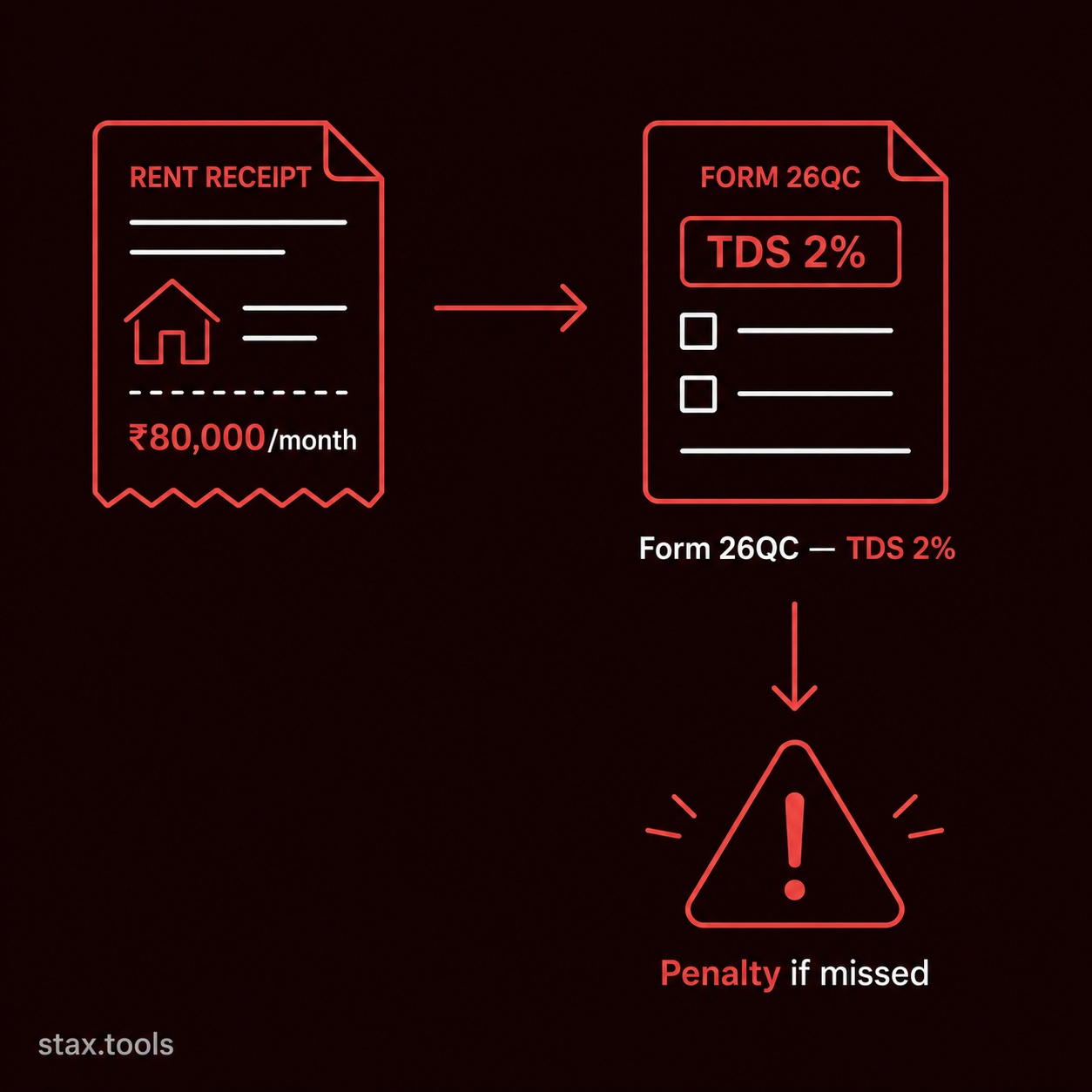 TDS on Rent Above ₹50,000: What Tenants Must DoMany tenants think TDS on rent is the landlord's problem. If you pay over ₹50,000 a month, you must deduct, deposit and file, and penalties are steep.5 min read
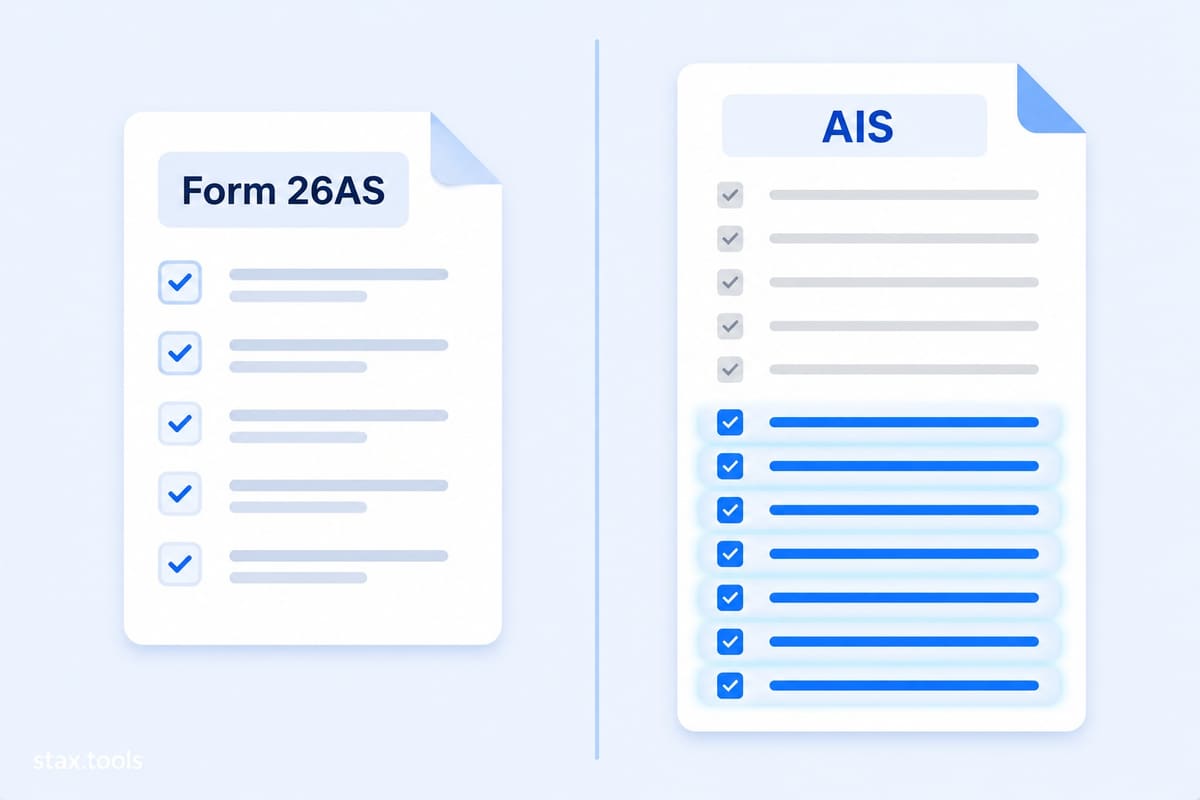 Form 26AS vs AIS: Spot and Fix ITR MismatchesForm 26AS vs AIS: filing ITR from 26AS alone is risky, as AIS also shows interest, dividends and MF redemptions. How to read both and fix mismatches.14 min read
 How to File ITR Online for FY2025-26 (AY 2026-27)ITR filing for FY2025-26 is open, with a July 31, 2026 deadline. How to file online: choosing the form, documents needed, regime selection and common mistakes.14 min read
Found this useful?
Browse 300+ free privacy-first tools — no login, no uploads, instant results.