
Capital Gains Tax on Mutual Funds FY2025-26: New Rates, the ₹1.25L Exemption, and How to File
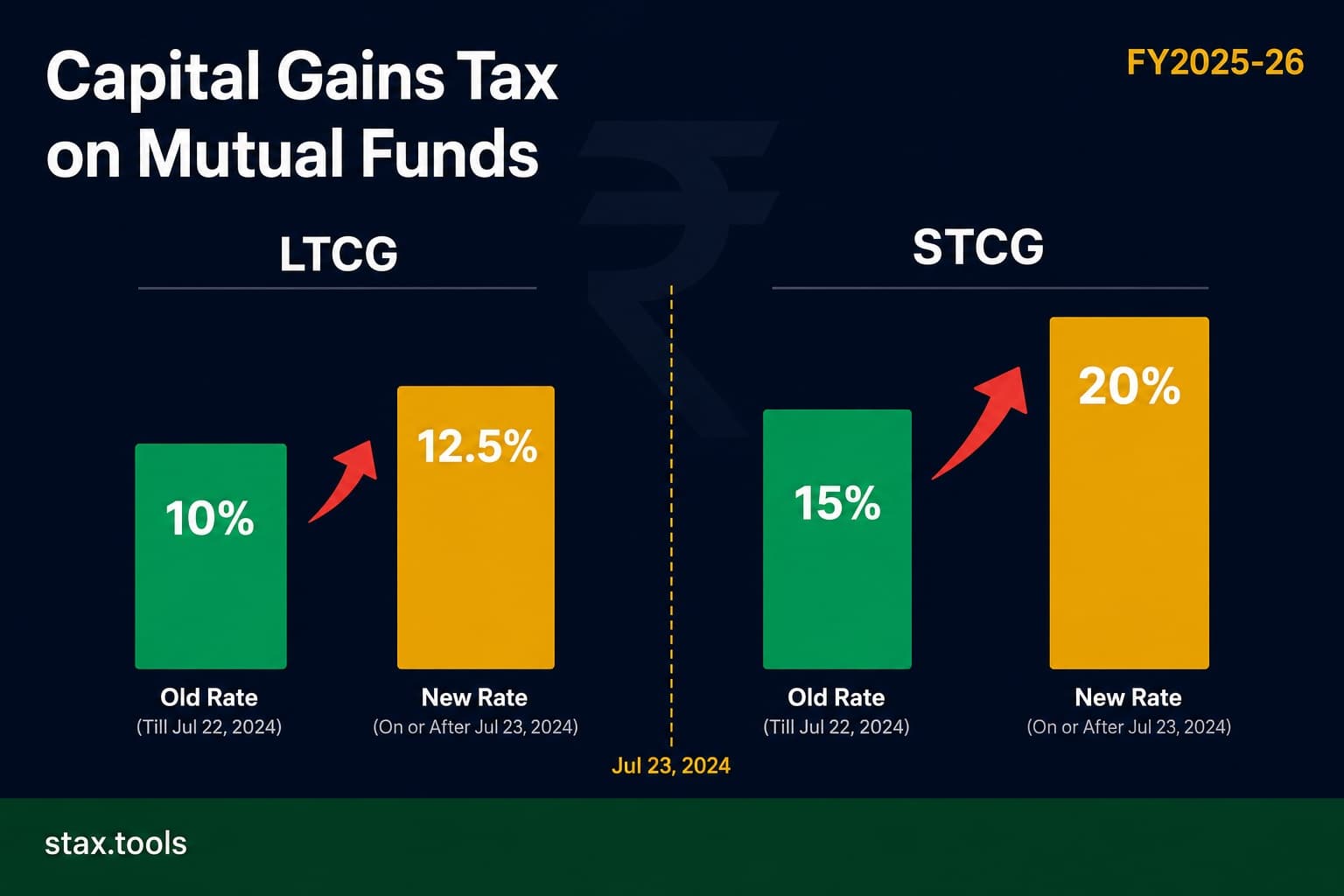
Finance Act 2024 changed LTCG on equity funds to 12.5% and STCG to 20% from July 23, 2024. Here's exactly what rate applies to your gains, how to claim the ₹1.25 lakh exemption, and how to report in ITR-2 this season.

This article is currently only available in English. A Français translation is coming soon.
Disclaimer: This article is for educational purposes only and does not constitute financial advice. The author is not a SEBI-registered advisor or certified financial planner. Please consult a qualified professional before making any investment or tax decisions.
The Finance Act 2024, effective July 23, 2024, changed the capital gains tax rates on mutual funds in ways that affect virtually every investor who sold equity fund units in FY2025-26. The rates are higher — but the annual exemption threshold is also wider. Here's the full picture before you open your ITR.
| Fund Type | Holding Period | Rate Before Jul 23, 2024 | Rate From Jul 23, 2024 | Annual Exemption |
|---|---|---|---|---|
| Equity funds≥65% in Indian equities | LTCG ≥ 12 months | 10%above ₹1 lakh | 12.5% ↑2.5ppabove ₹1.25 lakh | ₹1.25 lakh/yr |
| Equity funds | STCG < 12 months | 15% | 20% ↑5pp | None |
| Hybrid / balanced fundsequity allocation ≥65% | LTCG ≥ 12 months | 10% | 12.5% ↑2.5pp | ₹1.25 lakh/yr |
| Debt fundspurchased after Apr 1, 2023 | Any holding period | Slab rate | Slab rate No change | None |
| Debt fundspurchased before Apr 1, 2023 | LTCG ≥ 36 months | 20% with indexation | 12.5% without indexation Changed | None |
| International / FoFequity <65% | LTCG ≥ 24 months | 20% with indexation | 12.5% without indexation Changed | None |
Which rate applies depends on your sale date, not when the gain accrued. Units sold on or after July 23, 2024 fall under the new rates regardless of purchase date.
What Finance Act 2024 actually changed
The Union Budget presented on July 23, 2024 revised capital gains taxation across asset classes. For mutual fund investors, the five meaningful changes were:
1. Equity LTCG rate: 10% → 12.5%
The long-term capital gains tax on equity mutual funds rose by 2.5 percentage points. The annual exemption threshold also moved — from ₹1 lakh to ₹1.25 lakh — partially cushioning the impact for smaller investors.
2. Equity STCG rate: 15% → 20%
Short-term capital gains (units held under 12 months) are now taxed at a flat 20%. This is the sharpest increase and disproportionately affects investors who book profits within a year of SIP instalments or make frequent fund switches.
3. Holding periods: unchanged
The definition of what counts as "long-term" was not changed. Equity funds remain 12 months. The classification of a fund as "equity" (≥65% in Indian equities) is unchanged.
4. Debt fund indexation: removed for pre-2023 purchases
Debt mutual funds bought before April 1, 2023 previously qualified for 20% LTCG with indexation if held more than 36 months. From July 23, 2024, those same units are taxed at 12.5% without indexation. In high-inflation years, indexation was often worth more than the 7.5pp rate difference — so this is a genuine deterioration for long-held debt funds.
5. The sale date is the cutoff — not the accrual date
This is the point most investors misunderstand. If you sold equity fund units on July 22, 2024, the old 10% rate applies to the entire gain. If you sold the identical units on July 23, 2024, the new 12.5% rate applies to the entire gain. There is no proportional splitting by accrual period. The cutoff is binary.
The ₹1.25 lakh LTCG exemption: how it works in practice
The exemption applies jointly to LTCG from equity mutual funds and listed equity shares combined — it is a single annual limit, not per fund or per transaction.
Worked example — three funds sold in FY2025-26:
- Fund A (large-cap index): LTCG ₹60,000
- Fund B (flexi-cap): LTCG ₹45,000
- Fund C (ELSS, post 3-year lock-in): LTCG ₹55,000
- Total LTCG: ₹1,60,000
Less exemption: ₹1,25,000
Taxable LTCG: ₹35,000
Tax at 12.5%: ₹4,375 + 4% cess = ₹4,550
Now factor in equity shares. If you also had ₹30,000 LTCG from selling listed shares in the same year, your combined LTCG from all equity assets becomes ₹1,90,000 — still subject to one ₹1.25 lakh exemption. Taxable amount rises to ₹65,000, and tax becomes approximately ₹8,450.
The exemption resets every April 1. Unused exemption does not carry forward to FY2026-27. This asymmetry is why systematic LTCG harvesting — deliberately booking gains up to ₹1.25 lakh every year — makes sense for long-term investors who are holding unrealised gains in equity funds.
Debt funds: three scenarios depending on purchase date
Scenario 1 — Purchased after April 1, 2023:
These units are taxed at your income slab rate regardless of holding period, with no exemption and no special rate. Nothing in Budget 2024 changed this. If you're in the 30% bracket, your redemption proceeds are taxed at 30% plus surcharge plus cess. This rule was introduced by Finance Act 2023 and remains in place.
Scenario 2 — Purchased before April 1, 2023, held ≥36 months:
Before July 23, 2024, these units qualified for 20% LTCG with indexation — historically very favourable for long-term holders in inflationary periods. From July 23, 2024, redemptions are taxed at 12.5% without any indexation. Whether this is better or worse than the old treatment depends on how much inflation eroded the real return. In a scenario where your fund compounded at 8% and inflation averaged 6%, indexation would have sheltered most of the gain. Without it, you now pay 12.5% on the full nominal gain. For moderate holders the new 12.5% flat rate is likely still better than 30% slab — but not necessarily better than 20% with indexation.
Scenario 3 — Purchased before April 1, 2023, held <36 months:
Short-term gains for debt funds have always been taxed at slab rate. No change here.
The hybrid fund classification trap:
Funds that hold less than 65% in equities — equity savings funds, dynamic asset allocation funds running low equity allocations, conservative hybrid funds — are classified as debt for tax purposes. Their redemptions follow the debt taxation rules, not the 12.5% equity LTCG rate. Always verify your fund's stated equity allocation in the fund factsheet before assuming equity tax treatment applies.
International funds of funds (FoFs) investing in overseas equities are treated as debt funds since they typically don't maintain ≥65% in Indian equities. Their LTCG rate is now 12.5% without indexation for units held over 24 months.
How to get your consolidated capital gains statement
Your registrars (CAMS and KFintech) calculate and report all gain/loss figures — you do not need to manually compute NAV differences across hundreds of SIP transactions.
Where to download:
CAMS (mycams.com): Covers most large AMCs — HDFC, ICICI Prudential, Nippon, Aditya Birla, Kotak, DSP, Franklin, SBI, Sundaram, Tata, Mirae, and Axis. Log in → Statements → Capital Gains Report → select FY2025-26 (April 1, 2025 to March 31, 2026) → choose "Detailed" format.
KFintech (kfintech.com): Covers Quant, PPFAS (Parag Parikh), UTI, Canara Robeco, Edelweiss, Invesco, Motilal Oswal, WhiteOak, and others. Navigate to Reports → Capital Gains Statement.
MF Central (mfcentral.com): A joint platform by CAMS and KFintech that consolidates holdings from both registrars using your PAN. A single download from here covers nearly all mutual fund transactions. Select the "Detailed Capital Gains" report type.
Download the right date range: Select April 1, 2025 to March 31, 2026 for FY2025-26. A common mistake is downloading the calendar year (January–December) which misses April–December 2025 and March 2026 transactions.
The capital gains statement lists each transaction with: purchase date, redemption date, units, purchase NAV, sale NAV, cost of acquisition, and net gain or loss — classified separately as LTCG and STCG. This is the document you use to fill Schedule CG in your ITR.
Tax-loss harvesting: using losses to reduce your bill
Capital losses can offset capital gains and reduce tax liability. The rules under Section 70 and 74:
- Short-term capital loss (STCL) can be set off against both STCG and LTCG in the same year
- Long-term capital loss (LTCL) can only be set off against LTCG — not against STCG
- Losses not utilised in the current year can be carried forward for 8 assessment years
- Losses can only be carried forward if you file your ITR before the due date (July 31 for most individuals)
The harvesting strategy: If you hold unrealised losses in any fund near March 31, and you have realised gains elsewhere that will attract tax, selling the loss-making units before March 31 books the loss in FY2025-26 and reduces your net taxable gain. You can reinvest in the same fund immediately — India has no "wash sale" restriction.
One nuance: for LTCL to offset LTCG, the loss-making units must have been held over 12 months. For STCL to exist on equity funds, units must have been held under 12 months.
ELSS funds: Harvesting only becomes possible after the mandatory 3-year lock-in expires. If your ELSS units are in loss after three years and you're sitting on LTCG from other funds, this is worth considering.
How to report in ITR-2
Capital gains from mutual funds belong in Schedule CG (Capital Gains) of ITR-2. (If you have business income, use ITR-3.)
Within Schedule CG:
- Section A, Subsection (1) — 112A: Long-term capital gains from equity-oriented funds. Enter: full value of consideration, cost of acquisition (without indexation), and total LTCG. The ITR software applies the ₹1.25 lakh exemption automatically when computing tax.
- Section A, Subsection (3) — 111A: Short-term capital gains from equity funds taxed at 20%. Enter the total STCG.
- Section B — 112: LTCG from debt funds (purchased before April 1, 2023) at 12.5% without indexation.
- Section B (unlisted/non-STT): LTCG from debt/international funds taxed at 12.5% or slab, depending on holding period.
For debt fund redemptions taxed at slab rate (purchased post-April 2023), the gain forms part of your total income and is ultimately taxed under Section 115BAC (new regime) or normal slab rates (old regime) — it does not go into a flat-rate capital gains section.
To set off losses: fill Schedule CYLA (current year loss adjustment) to set off current year LTCL/STCL against gains, and Schedule BFLA (brought forward loss adjustment) if you have carried-forward losses from prior years.
Verify the pre-filled ITR: The income tax portal auto-populates capital gains data from registrar reports submitted to TRACES. Always cross-check this pre-filled data against your own MF Central statement. Known gaps include: fund switch transactions (treated as full redemption + fresh purchase), dividend reinvestment transactions (taxed as income when declared; units thus received have a new cost basis), and STP transactions that trigger gains each month.
| Profile | Situation in FY2025-26 | Tax implication | Recommended action |
|---|---|---|---|
| Salaried, ₹10L income, long-term SIP investor | Annual SIP redemptions; LTCG ₹95,000 | Below ₹1.25L exemption — zero equity LTCG tax | Declare in ITR-2 Schedule CG; no tax due |
| Salaried, ₹20L income, frequent switcher | STCG ₹1.2L from switching between equity funds within the year | ₹24,000 tax at 20% + cess = ₹24,960 | Hold units >12 months; switches are taxable redemptions |
| Retiree, ₹4L pension income | Debt fund (pre-2023 purchase) redemption; LTCG ₹3.5L (held >36 months) | 12.5% on ₹3.5L = ₹43,750; but total income may remain below rebate threshold | Check if total income (pension + gains) keeps you below ₹7L new regime rebate |
| 30% slab earner, active investor | LTCG ₹4L equity + STCG ₹1.5L equity + unrealised LTCL ₹80K in one fund | LTCG tax ≈₹34K; STCG tax ₹30K; harvesting LTCL reduces LTCG to ₹3.2L, saving ₹10K | Book LTCL before Mar 31; repurchase same fund next day |
Calculate your total FY2025-26 tax liability
The Income Tax Calculator lets you model your complete tax bill for FY2025-26, including capital gains alongside salary, rental income, and interest income. Enter your LTCG and STCG amounts separately — the calculator applies the flat rate to capital gains and the slab/regime logic to the rest.
The key insight most investors miss: capital gains are taxed at flat rates regardless of which income tax regime you choose. The decision between old and new regime affects only how your salary and other income is taxed — not the capital gains component. So if you're trying to reduce your capital gains tax burden specifically, regime choice won't help. But the right regime choice on your salary can still save meaningful amounts.
Use the SIP Calculator alongside the income tax calculator to model future corpus projections. At a 12.5% LTCG rate with ₹1.25 lakh annual exemption, systematic harvesting of gains every year across a 20-year SIP can keep the net tax burden significantly lower than waiting to redeem a large lump sum at the end — the annual exemption compounds in your favour if you use it.
My Take
The 2024 rate increase is real and worth understanding — but the concern is often overstated for the typical SIP investor. The ₹1.25 lakh annual LTCG exemption means anyone with modest equity gains continues to pay zero tax on the long-term equity portion. The rate change that deserves more attention is STCG at 20%, because fund switches are treated as redemptions: every time you move from one equity fund to another within 12 months, you've triggered STCG. Many investors who "rebalanced" or chased recent performance by switching funds in FY2025-26 may have generated STCG they weren't expecting. Check your capital gains statement specifically for STCG entries before filing — the tax at 20% adds up faster than the 12.5% LTCG that gets most of the headlines.
The debt fund situation is the genuinely complicated one. If you're holding pre-2023 debt fund units that were purchased partly for the indexation benefit, run the explicit calculation: is 12.5% on your nominal gain lower than what your slab rate would have been on the same gain without indexation? For many people in the 20% slab with moderate gains, the answer is yes — 12.5% is better than 20%. For those in the 30% bracket with inflation-heavy gains, the maths may go the other way.
Sources & methodology
Finance Act 2024 rate changes: Union Budget 2024–25 Finance Bill, specifically amendments to Sections 111A (STCG), 112A (equity LTCG), and 112 (debt LTCG) of the Income Tax Act. Effective date July 23, 2024 confirmed in CBDT notification on capital gains amendments. The revised ₹1.25 lakh annual exemption threshold confirmed in Finance Bill 2024 memorandum.
Debt fund taxation history: Finance Act 2023 (Amendment to Section 50AA) removed indexation for debt mutual funds purchased after April 1, 2023. Finance Act 2024 extended indexation removal to pre-2023 units redeemed on or after July 23, 2024 via amendment to Section 112.
Capital gains statement sources: CAMS investor portal, KFintech investor portal, and MF Central joint repository. Fund classification methodology (equity vs debt for tax) sourced from SEBI circular SEBI/HO/IMD/DF3/CIR/P/2017/114 on mutual fund categorisation.
ITR filing guidance: Income Tax India e-filing portal Help Section for AY2026-27, Schedule CG instructions. ITR-2 applicability for capital gains without business income confirmed under Rule 12 of Income Tax Rules. Loss set-off rules sourced from Sections 70 and 74 of the Income Tax Act.
Worked examples: All tax calculations use FY2025-26 slab rates under the new tax regime (Finance Act 2023 default) plus 4% health and education cess. Surcharge not applied in base examples for simplicity. Actual liability depends on total income, surcharge applicability, and applicable deductions under chosen regime.
The bottom line
For FY2025-26 ITR filing, the checklist: confirm which rate applies to each sale (the date of sale determines the rate, not when the gain accrued), download your consolidated capital gains statement from CAMS/KFintech for the full April 2025–March 2026 period, verify whether your hybrid or international funds qualify as equity, and cross-check the pre-filled ITR against your own statement before submission. The ₹1.25 lakh annual LTCG exemption absorbs modest equity gains — if your total stays below that, you owe nothing on the equity portion, but you must still declare it in Schedule CG. And if you have unrealised losses sitting in any fund, the time to act on them is before March 31, not after.
→ Calculate your FY2025-26 tax including capital gains — runs entirely in your browser, no data uploaded.
Grishma
Finance Content Writer
Grishma writes about personal finance, investing, and tax planning for Indian readers — translating complex regulatory changes into clear, actionable guidance.
More by Grishma →Found this useful?
Browse 235+ free privacy-first tools — no login, no uploads, instant results.