
SIP vs Lump Sum Investment: Which Builds More Wealth in 2026?
SIP and lump sum both grow money — but which is right for you depends on market conditions, your cash flow, and your risk tolerance. Here's the honest breakdown.

This article is currently only available in English. A 日本語 translation is coming soon.
Disclaimer: This article is for educational purposes only and does not constitute financial advice. The author is not a SEBI-registered advisor or certified financial planner. Please consult a qualified professional before making any investment or tax decisions.
The SIP vs lump sum debate comes up every time the market either crashes ("should I deploy now or spread it out?") or rallies ("have I missed the bottom?"). The answer is almost never black and white — it depends on your situation, the market cycle, and what you're actually optimising for.
Here's the honest breakdown, with the calculations to back it up.
What is a SIP?
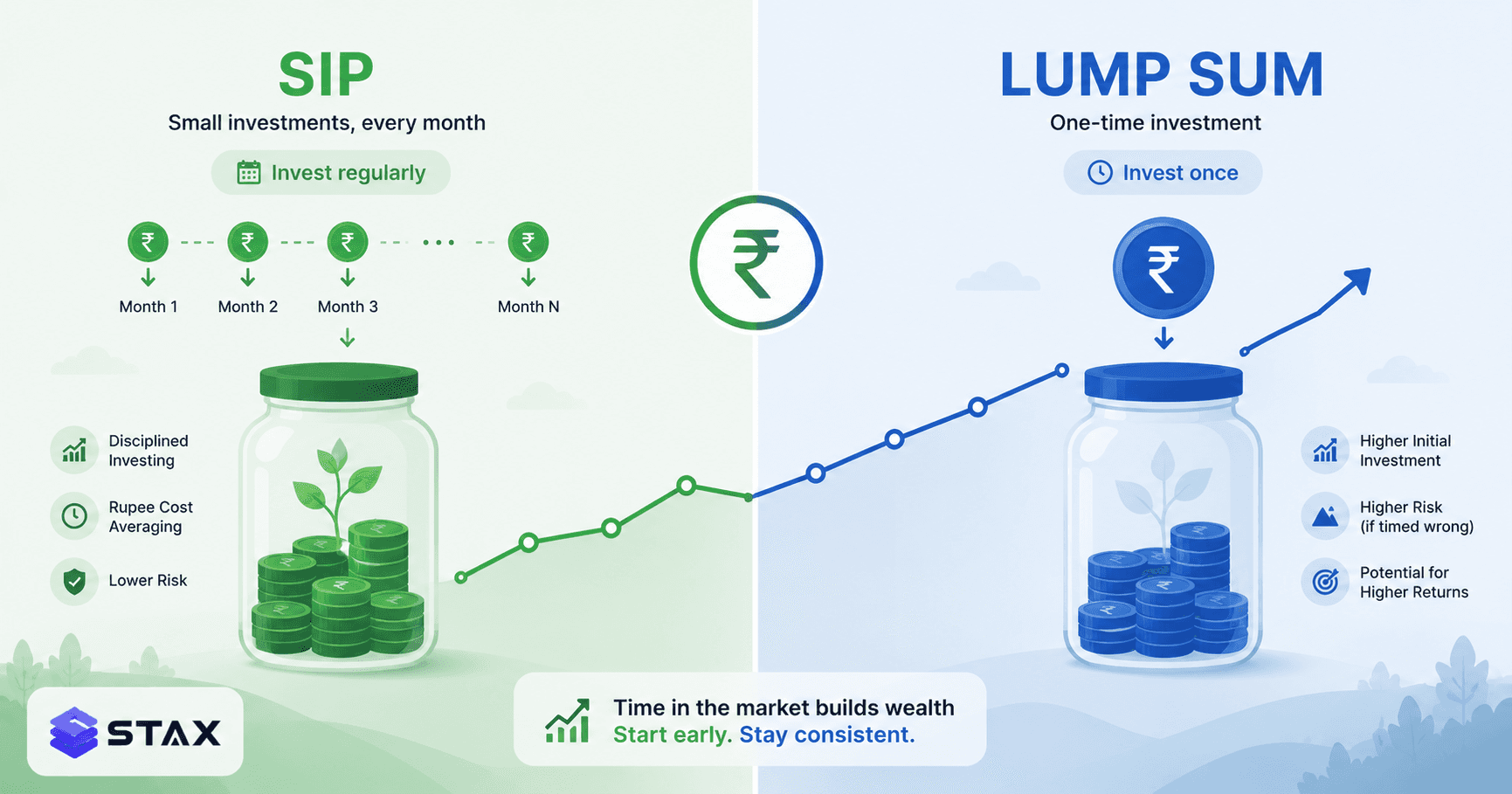
A Systematic Investment Plan (SIP) means investing a fixed amount — say ₹10,000 — into a mutual fund at regular intervals (monthly, quarterly). You buy units at whatever NAV (Net Asset Value) is on that date.
The key mechanical advantage: rupee cost averaging. When NAV is high, you buy fewer units. When NAV is low, you buy more. Over time, your average cost per unit tends to be lower than the average NAV during the period.
Try the SIP Calculator to model different investment amounts and return scenarios.
What is a lump sum investment?
You invest the entire amount at once, on a single date, at the current NAV. Your returns depend entirely on the NAV trajectory from that entry point.
Model this with the Lumpsum Calculator.
The mathematical case for each
When lump sum wins
If you invest ₹12,00,000 in a fund that returns 12% CAGR:
- Lump sum: ₹12,00,000 invested at year 0 → ₹37,26,994 after 10 years
- SIP of ₹10,000/month: ₹12,00,000 total invested over 10 years → ₹23,23,391 after 10 years
The lump sum generated ₹14 lakhs more. Why? Every rupee was invested for the full 10 years. SIP money invested in month 2 only works for 9 years 11 months; money invested in month 120 works for just 1 month.
Lump sum wins when markets go steadily up. If you invested a lump sum in April 2020 (market bottom post-COVID crash), returns over the next 3 years were extraordinary.
When SIP wins
If the market is volatile or you're entering near a peak:
Imagine a ₹12,00,000 lump sum invested in January 2008, just before a 60% crash. By March 2009, the value is ₹4,80,000. It took until 2013 to recover to ₹12,00,000 — 5 years just to break even.
A ₹10,000/month SIP starting January 2008 through the crash? You're buying units at 40 rupees, 30 rupees, even 20 rupees during the crash. By 2013, the SIP investor is significantly ahead of the lump sum investor's recovery — they accumulated more units at low prices.
SIP wins when markets are volatile or trending down. The averaging mechanism is most powerful when prices fluctuate significantly.
The honest truth: timing the market is nearly impossible
The theoretical advantage of lump sum assumes you invest at or near market bottoms. Knowing when the bottom is in real-time is not reliably possible — professional fund managers consistently fail to do it.
What we do know:
- Time in market beats timing the market — the longer your money is invested, the more compounding works for you
- Behavioural finance is real — lump sum investing is psychologically harder; investors tend to panic-sell after sharp drops
- Cash flow is real — most people don't have ₹12 lakhs sitting idle; they earn ₹10,000 per month of investable surplus
Practical recommendations
Choose SIP if:
- You have a regular income with monthly surplus (the most common situation for salaried individuals)
- You're new to investing and want to reduce emotional decision-making
- Markets are at or near all-time highs and you're uncertain about timing
- The investment horizon is 7+ years (SIP's averaging advantage plays out fully)
Choose lump sum if:
- You've received a windfall (bonus, inheritance, asset sale proceeds)
- Markets have recently corrected significantly (>20% from peak) and valuations look attractive
- Your investment horizon is 10+ years and you're confident in riding volatility
- You understand the psychological commitment of watching paper losses during downturns
Consider a hybrid approach: Invest 50% as a lump sum and the remaining 50% as a 12-month SIP. You get partial exposure immediately while averaging the rest. This is a common strategy for deploying bonus payouts.
What about Step-Up SIP?
A Step-Up SIP (also called a top-up SIP) increases your monthly contribution by a fixed percentage each year — typically 10–15%, aligned with salary increments. Since your investable surplus typically grows over time, a step-up SIP more accurately models your actual cash flows.
Use the Step-Up SIP Calculator to see how increasing contributions affect your long-term corpus.
Key numbers to remember
| Scenario | Monthly SIP | Tenure | Assumed CAGR | Corpus |
|---|---|---|---|---|
| Conservative | ₹5,000 | 20 yrs | 10% | ₹38.3 L |
| Moderate | ₹10,000 | 20 yrs | 12% | ₹98.9 L |
| Aggressive | ₹20,000 | 20 yrs | 14% | ₹2.6 Cr |
| Lump sum | ₹5,00,000 | 20 yrs | 12% | ₹48.2 L |
(All figures approximate. Use the calculators for precise scenarios with your numbers.)
Bottom line
For most salaried investors in India, SIP is the right default: it aligns with cash flows, removes timing decisions, and builds the investment habit. For lump sums received from bonuses or asset sales, deploying directly is mathematically superior in flat-to-rising markets — but splitting into a short-term SIP (6–12 months) adds a behavioural safety net.
Neither is universally superior. Both are dramatically better than not investing at all.
Tax implications: ELSS makes the SIP vs lump sum decision more nuanced
Equity Linked Savings Scheme (ELSS) funds are eligible for deduction under Section 80C (up to ₹1.5 lakh per year) under the old tax regime. This tax angle changes the SIP vs lump sum calculation.
ELSS via lump sum: if you invest ₹1.5 lakh in a single ELSS transaction, the entire amount is locked in for exactly 3 years from that date. You can claim the full ₹1.5 lakh deduction in that assessment year.
ELSS via SIP: each SIP instalment has its own 3-year lock-in from its investment date. A 12-month SIP to claim ₹1.5 lakh means the last instalment (₹12,500 in December) isn't unlocked until December of the third year. The unlocking is staggered rather than simultaneous.
Practical advice: if your goal is to deploy exactly ₹1.5 lakh into ELSS for Section 80C and you want a clean lock-in structure, a lump sum in April or May (start of the financial year) gives you maximum time in market and a clean 3-year window. If you're investing more than ₹1.5 lakh monthly, SIP in ELSS works fine — just expect staggered redemptions.
Under the new tax regime (which doesn't offer Section 80C deductions), this distinction disappears. ELSS is just another equity fund — evaluate it purely on returns, not tax benefits.
How to evaluate your SIP performance correctly
Most investors check SIP performance using absolute return or point-to-point NAV comparison — "I invested ₹10,000/month, it's now worth ₹18 lakhs." This is not wrong, but it's incomplete.
XIRR is the correct metric for SIPs. XIRR (Extended Internal Rate of Return) accounts for the fact that different SIP instalments were invested for different durations. The first ₹10,000 worked for 10 years; the last ₹10,000 worked for 1 month. XIRR gives you the actual annualised return on your entire investment.
Use the XIRR Calculator: enter each SIP date and amount as a cash outflow (negative), and the current value as a cash inflow (positive). The result tells you what equivalent fixed deposit rate would have given you the same outcome — making it easy to judge whether the equity risk was worth it.
A well-performing large-cap SIP over 10 years should show 11–14% XIRR. If you're seeing 7–9%, your fund's underperformance relative to its benchmark is worth investigating — consider switching to a low-cost index fund.
The mutual fund category choice matters as much as SIP vs lump sum
The SIP vs lump sum debate often gets more attention than the fund selection decision, which actually has a larger impact on outcomes.
Large-cap funds: less volatile, suitable for lump sum in falling markets, lower SIP averaging benefit since large caps don't fall as dramatically as small caps.
Mid-cap and small-cap funds: highly volatile, where SIP's averaging advantage is most powerful. Lump sum into a small-cap fund near an all-time high is a high-risk decision. SIP in small caps over 7–10 years consistently outperforms other strategies for wealth creation — with higher volatility along the way.
Index funds: passive funds tracking Nifty 50 or Nifty Next 50 have lower expense ratios (0.1–0.2% vs 1–2% for active funds). Over 15–20 years, the lower cost compounding advantage is substantial. For most retail investors, a Nifty 50 index SIP combined with a Nifty Next 50 or midcap 150 index SIP is the evidence-backed approach.
International funds: adding a 10–20% allocation to US or global index funds (via Nasdaq 100 or S&P 500 based India mutual funds) diversifies currency and economic risk. SIP works well here — currency fluctuations (rupee depreciation vs dollar appreciation) create their own averaging dynamic.
Common mistakes investors make with SIPs
Stopping SIPs during market downturns: this is the worst possible time to stop. A market fall means you're buying more units per ₹10,000. Stopping a SIP in a bear market locks in losses and eliminates the averaging benefit. If cash flow is the concern, reduce the SIP amount rather than stopping entirely.
Starting and stopping SIPs frequently: each new SIP start resets the rupee-cost averaging period. Frequent pauses and restarts create an irregular cost basis that's harder to track and often results in worse outcomes than a steady, unchanged SIP.
Not reviewing the fund annually: SIPs benefit from automation, but "set it and forget it" should not mean never reviewing fund performance. Once a year, compare your fund's 3-year and 5-year returns against its benchmark and category average. If it consistently underperforms, switching is reasonable.
Ignoring the expense ratio: a 1.5% expense ratio vs 0.2% on an index fund creates a ~1.3% annual drag. Over 20 years on a ₹10,000/month SIP, that difference compounds to lakhs of rupees. When choosing between two similarly-performing funds, always prefer the lower expense ratio.
Bottom line
For most salaried investors in India, SIP is the right default: it aligns with cash flows, removes timing decisions, and builds the investment habit. For lump sums received from bonuses or asset sales, deploying directly is mathematically superior in flat-to-rising markets — but splitting into a short-term SIP (6–12 months) adds a behavioural safety net.
Neither is universally superior. Both are dramatically better than not investing at all. Focus first on fund selection and expense ratios — then optimise for SIP vs lump sum within those parameters.
- SIP Calculator
- Lumpsum Calculator
- Step-Up SIP Calculator
- XIRR Calculator — for calculating actual returns on irregular investments
My Take
Lumpsum beats SIP mathematically in hindsight almost every time — but hindsight is not a strategy available to actual investors. In my view, the more honest question is: will you actually deploy the full amount at the right moment, or will you hesitate, wait for "more clarity," and miss the window entirely? Most people I know who had a ₹5–10 lakh lump sum in 2022–23 did not put it all in at once; they parked it in FDs and deployed it piecemeal. A 3-month STP — where you shift the lump sum from a liquid fund into your target equity fund over 12 weekly tranches — is the pragmatic middle ground that captures most of the mathematical upside while removing the psychological burden of a single big bet. If you have idle money sitting in a savings account right now, set up an STP today rather than waiting for the "right time."
Grishma
Finance Content Writer
Grishma writes about personal finance, investing, and tax planning for Indian readers — translating complex regulatory changes into clear, actionable guidance.
More by Grishma →Found this useful?
Browse 235+ free privacy-first tools — no login, no uploads, instant results.