
Your SIP Return Is Not CAGR — Understanding XIRR and Why the Difference Is Larger Than You Think
Most mutual fund investors confuse fund NAV growth (CAGR) with their personal return (XIRR). For SIPs, the gap can be 3–5 percentage points. Here's the math, a worked example, and how to calculate your actual return in minutes.

This article is currently only available in English. A हिन्दी translation is coming soon.
Disclaimer: This article is for educational purposes only and does not constitute financial advice. The author is not a SEBI-registered advisor or certified financial planner. Please consult a qualified professional before making any investment or tax decisions.
"I've been investing in this fund for 5 years and it has given 18% CAGR."
This sentence appears in personal finance forums, WhatsApp groups, and fund review comments hundreds of times a day. And it is almost certainly wrong — not because the fund didn't return 18% CAGR, but because the investor's personal return from a SIP into that fund is a completely different number.
The confusion costs investors real clarity about their portfolio. It causes some to stay in underperforming funds longer than they should. It causes others to be disappointed when they withdraw and the final amount doesn't match the NAV growth. This article clears up the distinction once and for all.
This article is for educational purposes only and does not constitute financial advice.
Myth: Fund CAGR = My Return
Fund CAGR measures how the fund's NAV has grown from one date to another. If a fund's NAV was ₹100 on May 1, 2021, and is ₹220 on May 1, 2026, the 5-year CAGR is:
CAGR = (220/100)^(1/5) − 1 = 17.1%
This is a point-to-point return. It measures the journey from NAV A to NAV B.
Your SIP return measures the growth of your actual investment — a series of ₹5,000 or ₹10,000 deposits made at different times, buying different quantities of units at different NAVs, ultimately redeemed on one date.
Your deposits are not all made at NAV 100. Some were made at 110, some at 130, some at 95 (after a correction), some at 170. Your return depends on the specific NAVs at which you invested — and the fund's point-to-point CAGR says nothing about those specific entry prices.
What XIRR actually measures
XIRR (Extended Internal Rate of Return) is the annualised return on a series of cash flows — outflows (your SIP instalments) and inflows (your redemption amount) at specific dates.
Formally, XIRR finds the rate r such that:
Sum of [ CF_i / (1 + r)^(d_i / 365) ] = 0
Where CF_i is each cash flow (negative for investments, positive for redemptions) and d_i is the number of days from the first cash flow to each subsequent one.
You cannot solve this equation by hand for more than 2–3 cash flows — it requires iteration. The Stax XIRR Calculator does this instantly from a list of investment dates and amounts.
A worked example: same fund, same period, very different returns
Scenario: Investor A puts ₹1,00,000 lump sum into Fund X on May 1, 2021. Investor B starts a ₹5,000/month SIP in the same fund on the same date.
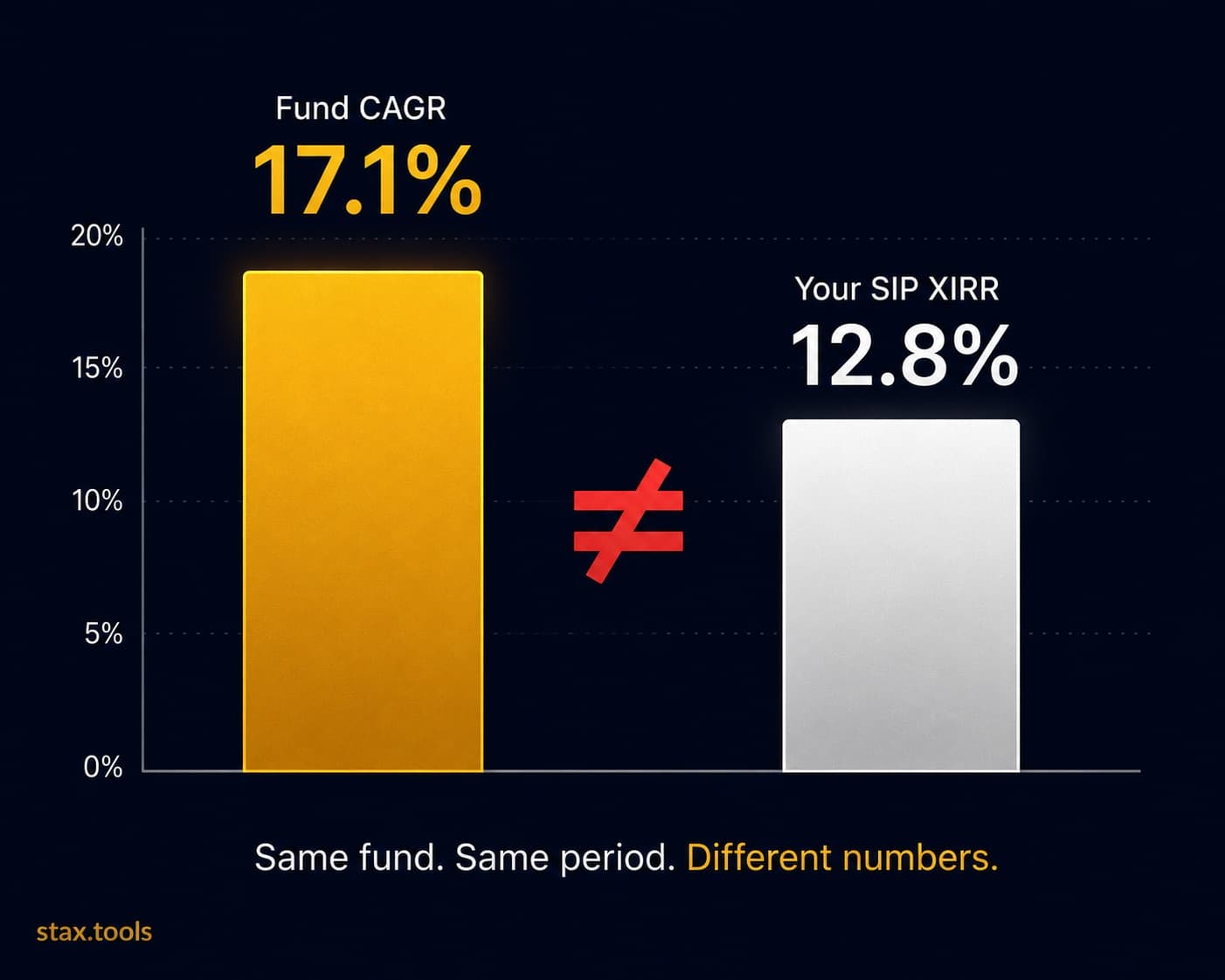
Fund X NAV: ₹100 in May 2021, ₹220 in May 2026. Fund 5-year CAGR: 17.1%.
Investor A (lump sum):
- Invested: ₹1,00,000 at NAV 100 → 1,000 units
- Value on May 1, 2026: 1,000 × ₹220 = ₹2,20,000
- CAGR/XIRR: 17.1% (for a single cash flow, CAGR = XIRR)
Investor B (₹5,000/month SIP for 60 months):
- Total invested: ₹3,00,000
- Units accumulated: depends on the NAV at each month's purchase date
- Assume the fund followed a typical equity path (gradual rise, a mid-period correction, recovery): average purchase NAV ≈ ₹148
- Total units ≈ 3,00,000 / 148 = 2,027 units
- Value on May 1, 2026: 2,027 × ₹220 = ₹4,45,940
- Total gain: ₹4,45,940 − ₹3,00,000 = ₹1,45,940
Investor B's XIRR on this SIP is approximately 12.8% — not 17.1%.
| Investor A | Investor B | |
|---|---|---|
| Investment type | Lump sum | SIP (₹5,000/month) |
| Total invested | ₹1,00,000 | ₹3,00,000 |
| Final value | ₹2,20,000 | ₹4,45,940 |
| Absolute gain | ₹1,20,000 | ₹1,45,940 |
| XIRR/CAGR | 17.1% | ~12.8% |
Both investors were in the same fund for the same period. The fund CAGR is 17.1% for both. But Investor B's personal XIRR is ~12.8% because their later investments (made at higher NAVs) hadn't had enough time to compound to the same extent as Investor A's single early purchase.
Why is the XIRR lower for SIPs in rising markets?
When markets trend upward over a long period, each successive SIP instalment is purchased at a higher price and has less time to compound to the final date. The earlier instalments — which had the most time — are a smaller proportion of the total corpus because the same ₹5,000 bought fewer units at higher prices.
Counter-intuitively, rupee cost averaging works in your favour during volatile or falling markets (you buy more units at lower prices), but in a steadily rising market, your personal XIRR will tend to be below the fund's point-to-point CAGR.
This is not a failure of SIP investing. It is arithmetic. The comparison is unfair: you didn't invest ₹3,00,000 in May 2021 and let it ride — you invested gradually. The lump-sum investor took a different (and in hindsight, better-timed) risk.
When XIRR can be higher than CAGR
If you made SIP investments during a market correction and the final valuation date is after recovery, your XIRR can exceed the fund CAGR measured from the same start date.
Example: Fund NAV was ₹100 in January 2020, fell to ₹70 in March 2020 (COVID crash), and recovered to ₹200 by December 2022. A SIP running through that period bought significant units at ₹70–₹90, which then doubled. The investor's XIRR over that period could meaningfully exceed the fund's 3-year CAGR from ₹100 to ₹200.
This is why experienced investors often say SIPs "work best in volatile markets." It is literally true in terms of XIRR.
XIRR vs CAGR: when to use each
| Use case | Correct metric | Why |
|---|---|---|
| Comparing two funds | CAGR (point-to-point, or rolling CAGR) | Standardised; removes the effect of different investment timings |
| Measuring your own SIP return | XIRR | Accounts for all your actual cash flows at actual dates |
| Measuring a lump-sum investment | CAGR = XIRR (same thing for one cash flow) | Identical result |
| Comparing your return to a benchmark | XIRR vs benchmark's CAGR | Apples-to-oranges unless you also calculate XIRR of the same SIP schedule into the benchmark |
| Deciding whether to continue a SIP | XIRR with current corpus value | Use today's value as a hypothetical redemption cash flow |
How to calculate your SIP XIRR
You need three things: the date and amount of every investment, and the current value of the portfolio.
In Excel or Google Sheets:
Use the =XIRR(values, dates) function. List each SIP amount as a negative number (outflow) and the current corpus value as a positive number (inflow) on today's date. The function returns an annualised rate.
Quick method: Use the Stax XIRR Calculator — enter your SIP amount, start date, and current value, and it estimates your XIRR without needing a full transaction history. For exact figures, enter individual transactions if you have them.
From your fund house/broker: Zerodha, Groww, Kuvera, MFU, and most AMC portals now show XIRR next to each folios return. If yours shows "Absolute Return" or "Simple Return," that is not annualised and is not XIRR — look for the XIRR or "Annualised Return" figure explicitly.
The number to actually benchmark against
If you want to know whether your SIP into a fund beat a passive alternative, the fair comparison is:
What XIRR would the same monthly SIP amounts, on the same dates, have produced in a Nifty 50 index fund?
Not the Nifty 50 point-to-point CAGR — the Nifty 50 XIRR on the same cash flow schedule. This is the number serious fund analysts use.
A fund that delivered 13% XIRR for your SIP while the same SIP into Nifty 50 would have delivered 12.1% XIRR has added value. A fund that delivered 13% XIRR while the Nifty 50 XIRR on the same schedule was 14.3% has not — regardless of whether the fund's own CAGR was 15%.
By Grishma, personal finance writer at Stax Tools. XIRR calculation methodology follows SEBI's return calculation standards for mutual funds. Worked example figures are illustrative; actual returns depend on specific NAV history.
Sources & methodology
- SEBI Circular SEBI/IMD/CIR No. 2/198647/2008 — Standardisation of performance reporting methodology
- AMFI Best Practices Guidelines Circular No. 135/BP/82/2019-20 — XIRR as the standard SIP return metric
- Excel XIRR function documentation — Microsoft, docs.microsoft.com
Grishma
Finance Content Writer
Grishma writes about personal finance, investing, and tax planning for Indian readers — translating complex regulatory changes into clear, actionable guidance.
More by Grishma →Found this useful?
Browse 235+ free privacy-first tools — no login, no uploads, instant results.