
ELSS vs PPF: Which Section 80C Option Actually Wins in FY2026-27?
With RBI cutting rates 50 bps in 2025–26 and PPF at 7.1%, the ELSS vs PPF calculus has shifted. Here's which ₹1.5 lakh 80C investment makes more sense now — with 10-year return data, lock-in comparison, and tax treatment side by side.

This article is currently only available in English. A Français translation is coming soon.
Disclaimer: This article is for educational purposes only and does not constitute financial advice. The author is not a SEBI-registered advisor or certified financial planner. Please consult a qualified professional before making any investment or tax decisions.
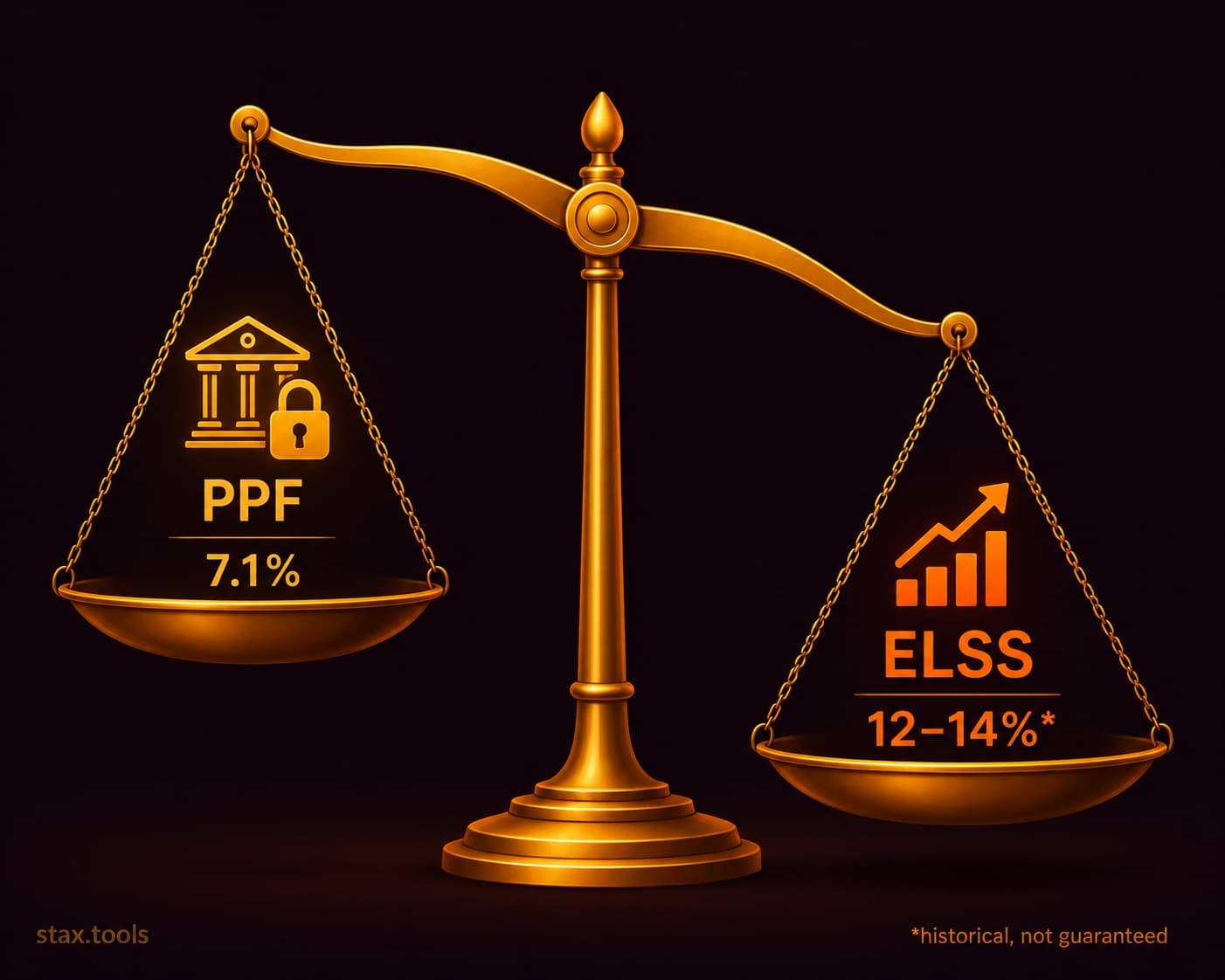
PPF's interest rate has been 7.1% since April 2020 — unchanged through six years of rate cycles. When RBI held repo at 6.5% through most of FY2024–25 and then cut 50 basis points by March 2026, PPF's relative attractiveness softened further. Meanwhile, the Nifty 50 delivered roughly 14–16% CAGR over the decade ending December 2025 and several top ELSS funds have 10-year SIP XIRRs above 13%.
The numbers have shifted enough that the standard answer — "PPF for safe money, ELSS for growth" — needs updating with actual figures.
This article is for educational purposes only and does not constitute financial advice. Tax laws change; consult a chartered accountant for your specific situation.
Side-by-side comparison
| Feature | PPF (Public Provident Fund) | ELSS (Equity Linked Savings Scheme) |
|---|---|---|
| Section 80C deduction | ✅ Up to ₹1.5 lakh | ✅ Up to ₹1.5 lakh |
| Lock-in period | 15 years (partial withdrawal from Year 7) | 3 years (shortest among 80C options) |
| Returns | 7.1% p.a. (government-set, quarterly review) | Market-linked; ~12–15% CAGR historically (not guaranteed) |
| Return guarantee | ✅ Guaranteed by sovereign | ❌ Market risk |
| Tax on returns | Fully exempt (EEE status) | LTCG above ₹1.25 lakh taxed at 12.5% |
| Tax on maturity | Fully exempt | LTCG at 12.5% (post-April 2024 Budget change) |
| Equity exposure | Zero | 80%+ equity (SEBI mandated) |
| Loan against investment | ✅ From Year 3 | ❌ Not available |
| Minimum investment | ₹500/year | ₹500 (many funds accept SIP at ₹500) |
| Maximum 80C benefit | ₹1.5 lakh | ₹1.5 lakh |
| Extension after maturity | ✅ In 5-year blocks | N/A (open-ended after 3-year lock-in) |
Calculate your PPF maturity amount at the Stax PPF Calculator.
The 10-year return comparison
The honest way to compare is not by picking the best ELSS vintage — it's by using a realistic range.
Based on Value Research data as of December 2025, the median 10-year SIP XIRR across ELSS category funds is approximately 12.8%, with the top quartile above 14.5% and the bottom quartile around 10.2%. All figures are post-expense ratio, pre-tax.
PPF at 7.1% compounded annually, with the EEE tax treatment:
| Invested per year | Over 15 years (PPF) | Over 15 years (ELSS at 12% post-tax)* |
|---|---|---|
| ₹50,000 | ₹13.8 lakh | ₹19.7 lakh |
| ₹1,00,000 | ₹27.7 lakh | ₹39.4 lakh |
| ₹1,50,000 | ₹41.5 lakh | ₹59.1 lakh |
*ELSS post-tax estimate assumes LTCG of 12.5% on gains above ₹1.25 lakh annually, which is approximate — actual tax depends on redemption pattern and annual gains.
At 12% post-tax, ELSS wins by approximately 42% over 15 years on the ₹1.5 lakh annual investment. At 10% (a pessimistic ELSS scenario), ELSS still produces ₹51.8 lakh versus PPF's ₹41.5 lakh — roughly a 25% advantage. PPF would only match ELSS over 15 years if equity markets delivered below ~8% post-tax CAGR for the full period.
Where PPF genuinely wins
The comparison above should not send everyone into ELSS. PPF has real advantages that numbers don't fully capture.
Sovereign guarantee: PPF is backed by the Government of India. Regardless of what happens to equity markets, banks, or fund houses, your PPF principal and interest are safe. For investors with low risk tolerance, near retirement, or those who cannot afford a temporary 30–40% drawdown (which equity markets produce every few years), this matters enormously.
Tax treatment: PPF is one of the few remaining EEE (Exempt-Exempt-Exempt) instruments — no tax on contribution (via deduction), no tax during accumulation, no tax on maturity. ELSS lost some of this advantage in the Union Budget 2018, when LTCG above ₹1 lakh was taxed for the first time. The Budget 2024 raised that threshold to ₹1.25 lakh and changed the LTCG rate to 12.5%, but the EEE status is now gone.
Loan facility: From Year 3 to Year 6, you can borrow against your PPF at a low interest rate (currently 1% above PPF rate = 8.1%). This is a unique liquidity feature no other 80C instrument offers.
Sequencing in the old tax regime: In the old regime with 30% tax bracket, a ₹1.5 lakh PPF contribution saves ₹46,800 in tax (₹1.5 lakh × 31.2% with cess). After receiving 7.1% EEE, the effective return is considerably higher for high-bracket taxpayers. However, this benefit only applies to those who have chosen the old regime — an increasingly smaller cohort as the new regime defaults improve each budget.
Where ELSS wins
The only 3-year 80C lock-in: All other popular 80C instruments lock your money for longer — ULIP is 5 years, NSC is 5 years, PPF is 15 years, 5-year FD is 5 years. ELSS's 3-year lock-in is the shortest in the category. If you might need the money in 5–7 years, ELSS is the only option that doesn't trap it.
Diversification potential: ELSS funds invest in equities and can hold large-cap, mid-cap, or multi-cap portfolios depending on the fund mandate. They provide equity market exposure with the discipline of a 3-year lock-in that prevents panic selling. For investors who otherwise park savings in savings accounts, ELSS is often the first productive market exposure.
Wealth creation in the accumulation phase: If you are 25–35 years old, have job security, have an emergency fund in place, and are investing for 15+ years, the historical data strongly favours equity. ELSS at 12–14% compounded over 20 years on ₹1.5 lakh/year produces materially more wealth than PPF, even after accounting for LTCG.
The new tax regime complication
Most new-regime taxpayers cannot claim the Section 80C deduction at all. If you have opted for the new regime (the default for FY2024–25 onward if no declaration is made), neither PPF contributions nor ELSS investments reduce your taxable income.
This significantly changes the decision:
- PPF still earns 7.1% EEE, so the interest and maturity remain tax-free — it remains a valid fixed-income instrument for the new-regime taxpayer, just without the 80C deduction benefit
- ELSS, without the deduction, is simply an equity mutual fund with a 3-year lock-in — there are better options (flexi-cap funds, index funds) without any lock-in
Bottom line for new-regime taxpayers: The 80C framework is largely irrelevant for investment decisions. Choose investments on their own merits.
Who should choose what
Choose PPF if:
- You are in the old tax regime and value guaranteed, tax-free returns
- You are within 10–15 years of retirement and cannot tolerate market volatility
- You want liquidity via the PPF loan facility
- Your PPF account already has a significant corpus and you want to extend it in 5-year blocks post-maturity
Choose ELSS if:
- You are in the old tax regime and want to exhaust your 80C limit with equity exposure
- You are under 40, have a long investment horizon (15+ years), and can tolerate interim drawdowns
- You need the shortest possible lock-in within 80C options
- You are starting equity investing and want the discipline of a lock-in to prevent early redemption
Consider both if:
- You want to split your ₹1.5 lakh 80C allocation between guaranteed (PPF) and growth (ELSS) — a barbell approach that many fee-only advisers recommend
Use the Stax PPF Calculator to project your PPF corpus under different contribution scenarios.
By Grishma, personal finance writer at Stax Tools. Return figures are historical and not indicative of future performance. Tax treatment reflects Finance Act 2024; consult a CA for current applicability.
Sources & methodology
- Value Research — ELSS category 10-year SIP XIRR data, December 2025 (valueresearchonline.com)
- Ministry of Finance Notification, PPF Interest Rate — finmin.nic.in, April 2020 onwards
- Finance Act 2024 — Union Budget FY2024–25, LTCG provisions for equity MFs
- SEBI Circular on Scheme Categorisation and Rationalisation — SEBI/HO/IMD/DF3/CIR/P/2017/114 (ELSS minimum equity definition)
Grishma
Finance Content Writer
Grishma writes about personal finance, investing, and tax planning for Indian readers — translating complex regulatory changes into clear, actionable guidance.
More by Grishma →Found this useful?
Browse 235+ free privacy-first tools — no login, no uploads, instant results.