
How Your CIBIL Score Is Calculated — and the 5 Factors That Actually Move It
FAQ-style explainer: what makes up a CIBIL TransUnion score, why it matters for home and personal loans, which behaviours increase it fastest, and what actually hurts it that most people don't know about.

This article is currently only available in English. A Français translation is coming soon.
Disclaimer: This article is for educational purposes only and does not constitute financial advice. The author is not a SEBI-registered advisor or certified financial planner. Please consult a qualified professional before making any investment or tax decisions.
This article is for educational purposes only and does not constitute financial advice.
What is a CIBIL score and what range is it on?
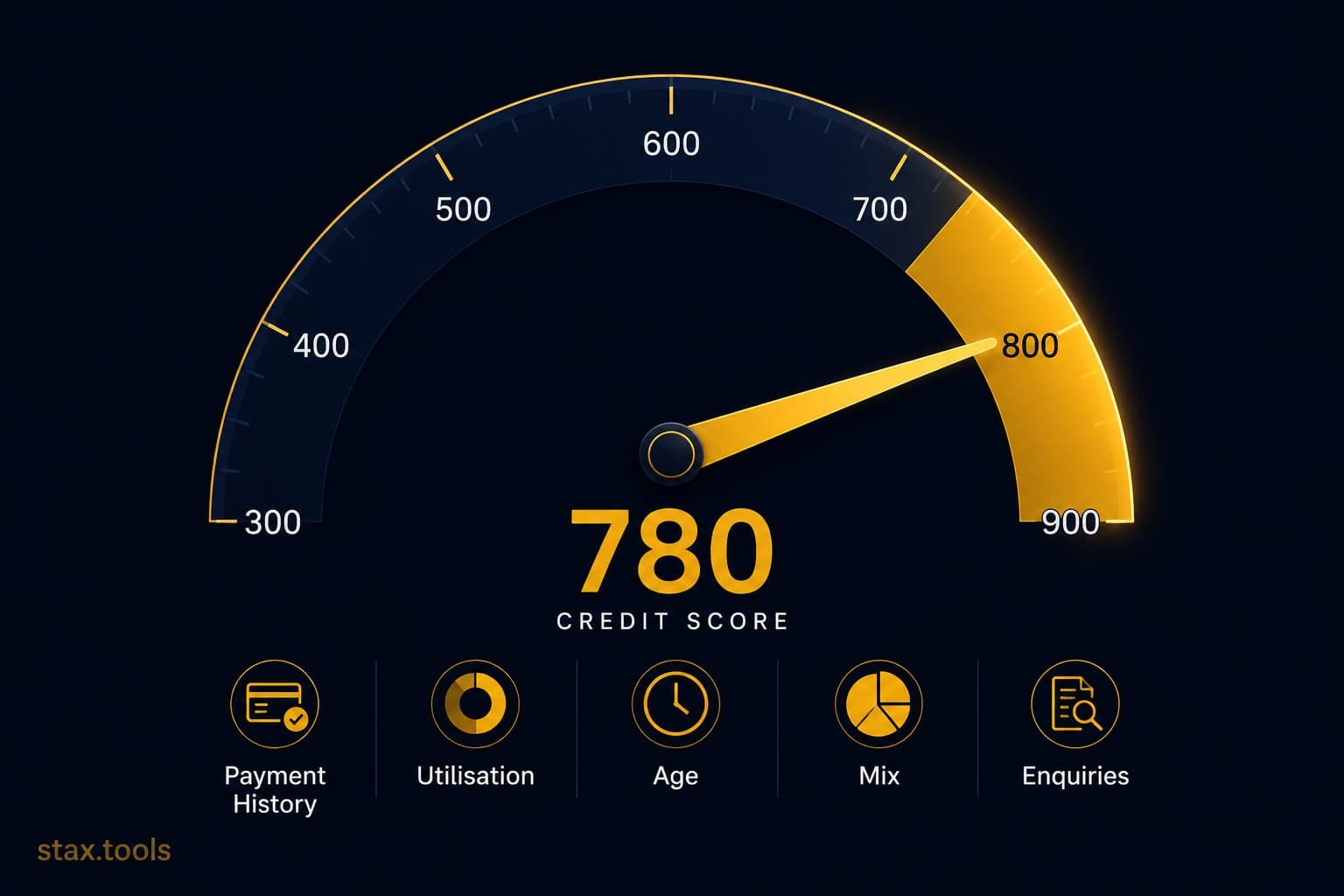
A CIBIL TransUnion score is a three-digit number between 300 and 900 that summarises your creditworthiness. It is calculated by TransUnion CIBIL based on your credit history — loans, credit cards, repayment behaviour — sourced from member banks and NBFCs.
Three other credit bureaus operate in India (Equifax, Experian, CRIF High Mark) and produce their own scores on similar scales. CIBIL is the most widely used by lenders.
| Score range | Rating | Loan approval likelihood |
|---|---|---|
| 750–900 | Excellent | High — best interest rates |
| 700–749 | Good | High — standard rates |
| 650–699 | Fair | Moderate — higher rate or stricter terms |
| 600–649 | Poor | Low — many lenders decline |
| 300–599 | Very poor | Very low — specialised lenders only |
| –1 or 0 | No history | First-time borrower; no score yet |
Most large banks (SBI, HDFC, ICICI, Axis) require a minimum CIBIL score of 700–750 for home loan approval at standard rates. Personal loan and credit card approvals typically require 720+.
What are the 5 factors that determine the score?
CIBIL does not publish its exact algorithm. However, TransUnion's published framework and industry research indicate the score is driven primarily by five factors:
1. Payment history (~35% weight)
Whether you pay EMIs and credit card bills on time is the single most important factor. A single missed payment can drop a 780 score by 50–80 points. Two consecutive missed payments on a loan can drop it by 100+ points. Payments reported as "written off" or "settled" (settled for less than full amount) are the most damaging — they remain on record for 7 years.
Action: Set up auto-pay for at least the minimum due on every credit card. EMI mandates should never lapse.
2. Credit utilisation ratio (~30% weight)
Your credit utilisation is the percentage of your total credit card limit that you use. If your combined card limit is ₹2 lakh and your outstanding balance is ₹60,000, your utilisation is 30%.
High utilisation signals financial stress. A utilisation ratio above 30% starts to negatively impact your score. Above 50%, the impact is significant. The ideal range is under 30% — with under 10% producing the best scores.
Commonly misunderstood: Even if you pay your balance in full every month, your score is calculated based on the balance at statement generation date (when the bank reports to CIBIL), not the due date. If you spend ₹80,000 on a ₹1 lakh limit card and then pay it before the due date, CIBIL still sees 80% utilisation for that month.
Action: Either pay a partial payment before the statement date, or request a credit limit increase from your bank.
3. Credit age (~15% weight)
The longer your credit history, the more data CIBIL has to assess your reliability. This factor considers both the age of your oldest account and the average age of all accounts.
Closing your oldest credit card (even if unused) reduces your average credit age and can lower your score by 10–30 points. It also reduces your total credit limit, which increases your utilisation ratio.
Action: Keep your oldest credit card open and use it for a small recurring purchase once every 3–4 months to prevent it from being marked inactive.
4. Credit mix (~10% weight)
Lenders prefer borrowers who have managed multiple types of credit: a home loan (secured, long-term), a car loan or personal loan (unsecured, medium-term), and a credit card (revolving). A mix demonstrates you can manage different repayment structures.
Someone with only credit cards scores lower on this dimension than someone with a combination of loans and cards — even if repayment history is identical.
Action: Don't take unnecessary loans just for a credit mix. But if you need a loan, know that a secured loan (gold loan, loan against property) managed well does improve your score.
5. New credit enquiries (~10% weight)
Every time you apply for a loan or credit card, the lender makes a "hard enquiry" on your CIBIL report. Multiple hard enquiries in a short period signal financial distress — you appear to be seeking credit urgently across multiple sources.
A single enquiry typically drops your score by 5–10 points temporarily. Five enquiries in 30 days can drop it by 30–50 points and triggers a "high enquiry volume" flag in lender risk models.
Soft enquiries (when you check your own CIBIL score, or when banks make pre-approved offer checks) do not affect your score.
How long does it take to improve a score?
There is no shortcut to a high credit score — it is built through consistent behaviour over time.
| Action | Expected score impact | Timeframe |
|---|---|---|
| Clear all overdue EMIs | +50 to +100 points | Visible in 1–2 reporting cycles (1–2 months) |
| Reduce utilisation to under 30% | +20 to +50 points | Visible next statement cycle |
| No new loan/card applications | +10 to +20 points | Gradual over 6–12 months |
| Consistent on-time payments | Prevents decay; builds trust | Ongoing |
| Dispute inaccurate records | +20 to +100 points | 30–45 days for resolution |
A score of 650 can realistically reach 720–740 within 12–18 months if you clear all overdues, reduce utilisation, and make no new enquiries. A 720 can reach 780+ within 18–24 months of disciplined behaviour.
How to check your free CIBIL score
Every individual is entitled to one free CIBIL report per year at cibil.com. Many banks (HDFC NetBanking, Axis app, Bajaj Finserv) show your current score for free on their app dashboards without a hard enquiry. Paytm, BankBazaar, and Paisabazaar also provide free score checks using soft enquiries only.
Check your report — not just the score — at least once a year. Errors in CIBIL reports are more common than most people realise: duplicate accounts, incorrect DPD (Days Past Due) entries, loans you didn't take (identity fraud signals). Disputes can be raised online at cibil.com/dispute.
Does a credit card you never use hurt your score?
No — an inactive card with zero balance does not hurt your score. However, if the card is closed by the bank for non-use, your total credit limit drops (worsening utilisation) and your average credit age may shorten. Make a small transaction every quarter to keep the card active.
Does carrying a credit card balance help your score?
No. The widespread belief that "carrying a small balance builds credit" is a myth in the Indian context. Paying your full balance every month before the statement date produces the best score outcomes. Carrying a balance means paying 36–42% annual interest on most cards for no credit score benefit.
If you have credit card debt, the Stax Credit Card Payoff Calculator shows the exact interest cost of different payoff timelines and how much you save by paying above the minimum.
By Grishma, personal finance writer at Stax Tools. Score weighting estimates are based on TransUnion's published credit factor framework; exact weights are proprietary.
Sources & methodology
- TransUnion CIBIL — How CIBIL Score is Calculated, cibil.com/faq
- RBI Master Direction — Credit Information Companies (Regulation) Act, 2005
- TransUnion CreditVision — factor weightings framework (publicly disclosed)
Grishma
Finance Content Writer
Grishma writes about personal finance, investing, and tax planning for Indian readers — translating complex regulatory changes into clear, actionable guidance.
More by Grishma →Found this useful?
Browse 235+ free privacy-first tools — no login, no uploads, instant results.