
CII Wants the ₹10 Fuel Excise Cut Rolled Back: What It Means for Your Petrol Bill
The Confederation of Indian Industry has proposed a gradual rollback of the ₹10/litre fuel excise reduction. Here's the real ₹ impact on your monthly fuel spend.

This article is currently only available in English. A Español translation is coming soon.
Disclaimer: This article is for educational purposes only and does not constitute financial advice. The author is not a SEBI-registered advisor or certified financial planner. Please consult a qualified professional before making any investment or tax decisions.
What happened
On 10 May 2026, the Confederation of Indian Industry (CII) released a five-point policy plan in response to the ongoing West Asia crisis, recommending that the government gradually roll back the ₹10 per litre excise duty reduction on petrol and diesel as global crude oil prices stabilise. The excise cut had been introduced earlier as a relief measure to shield Indian households from imported energy inflation. CII's argument is that with global crude prices easing from their conflict-driven highs, the temporary excise relief is no longer fiscally justified and the revenue is needed for capex commitments in the FY27 budget. The Finance Ministry has not yet responded, but the proposal has already moved bond markets and adjusted petrol price expectations for the second half of 2026.
What this actually means
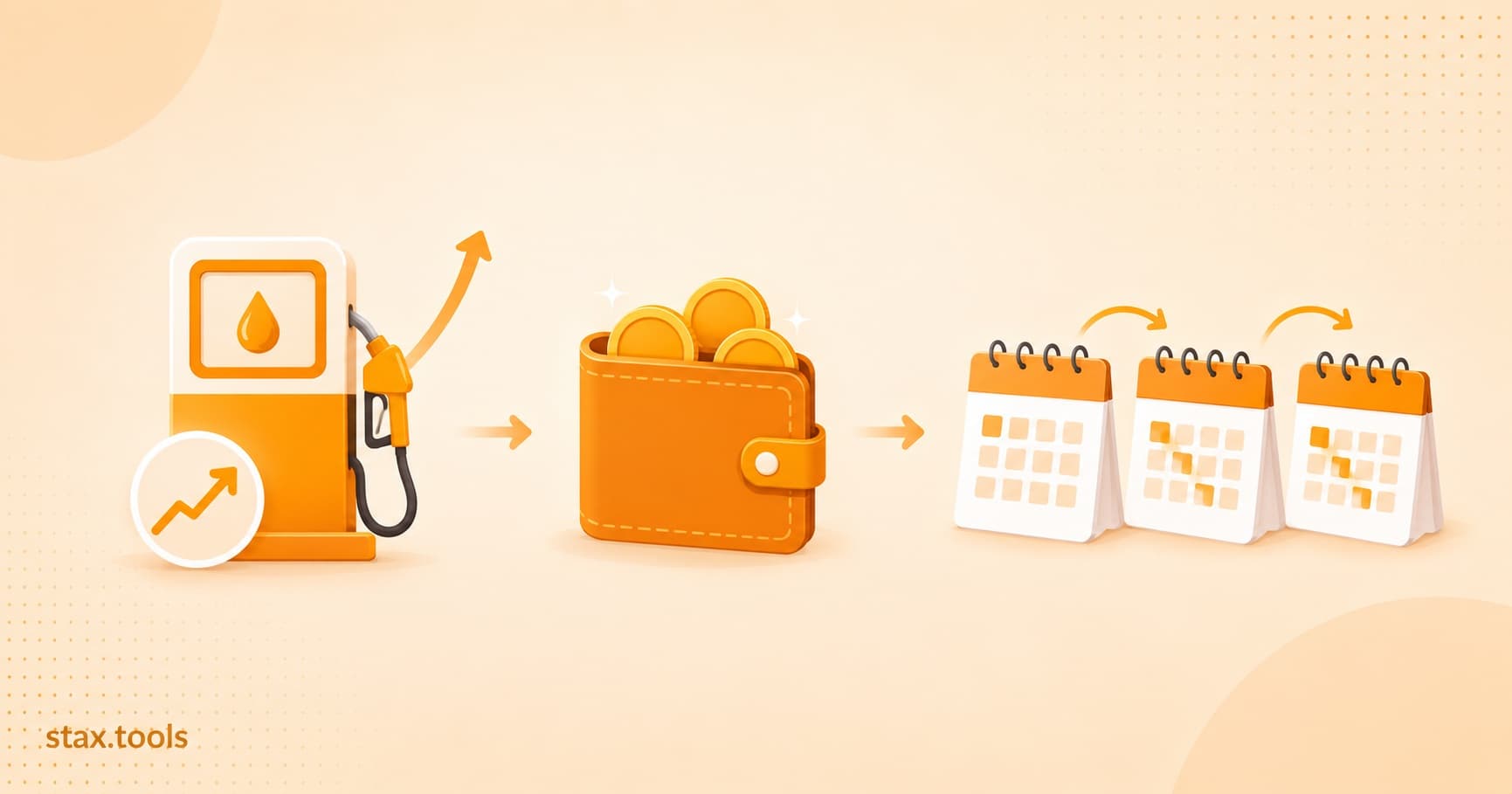
A "gradual rollback" means the ₹10 per litre relief that has been keeping petrol around ₹103 a litre in Mumbai (and ₹94 in Chandigarh) would be withdrawn in steps — likely ₹2–3 per litre per phase, spaced 60–90 days apart. The full unwind would take about 6–9 months. At each step, pump prices climb, and the cascading effect filters into transport costs for everything else: groceries that ride trucks, vegetables shipped across state lines, the auto fare you pay every morning.
Three groups feel this most directly. Two-wheeler commuters spend roughly 7–9% of their disposable income on fuel, the highest share of any vehicle class. A ₹10 per litre rise on top of today's price increases their fuel-as-share-of-income by 90 basis points. Small-business delivery operations running diesel three-wheelers and small commercial vehicles face the largest hit — diesel typically moves in lockstep with petrol, and a fleet of 5 vehicles each doing 200 km a day at 16 km/litre adds up to a ₹4,500 daily cost rise once the rollback completes. Salaried metro-commuters with cars in the 12–16 km/litre range see ₹2,000–₹3,000 added to their monthly fuel spend by the time the rollback finishes — a real cost that won't be offset by the modest 3–4% increments that most companies are budgeting for FY27 salaries.
How it affects you — real ₹ numbers
Let's work through three specific household profiles to make the impact concrete.
Profile 1: Two-wheeler commuter in Mumbai. Daily commute of 25 km on a 100cc scooter at 50 km/litre. Current monthly fuel spend: about ₹1,070 (assuming 22 working days and current Mumbai petrol price near ₹103.54/litre). After a full ₹10/litre rollback over 6 months, petrol moves to about ₹113.54, and monthly spend rises to ₹1,170 — an extra ₹100 a month, ₹1,200 a year. Modest in absolute terms, but it's 9.4% of fuel cost on top of an already-elevated base.
Profile 2: Bengaluru salaried, drives a small petrol car 1,200 km a month at 14 km/litre. Current fuel spend in Bengaluru (petrol around ₹101/litre) is ₹8,660 a month. After full rollback (petrol around ₹111), the same usage costs ₹9,514 — an additional ₹854 a month, or ₹10,250 a year.
Profile 3: Small business with one diesel SUV doing 2,000 km a month at 12 km/litre. Diesel currently around ₹89.30 a litre in most metros translates to a monthly spend of ₹14,883. Assuming diesel moves the same ₹10 per litre upward (₹99.30), monthly spend rises to ₹16,550 — an additional ₹1,667 a month or roughly ₹20,000 a year. For a small trader or solo professional, that's a ₹20,000 hole in the annual P&L that has to come out of margin or be passed on to customers.
Profile 4: Two-car family in Delhi running a petrol sedan (15 km/litre, 1,500 km/month) and a diesel SUV for weekend travel (10 km/litre, 600 km/month). Combined monthly fuel spend today at Delhi prices is around ₹15,750. After a full rollback, the same usage rises to roughly ₹17,250 — an additional ₹1,500 a month, or ₹18,000 a year. The kicker for families with two vehicles is that fuel is rarely the only cost moving: vehicle insurance premiums are also rising 8–12% year-on-year, and service centre labour rates have moved up roughly 6% in 2026 alone. Treating fuel as a standalone budget line misses the cumulative pressure on the overall vehicle running cost.
These numbers assume only the excise rollback effect. They ignore any further crude price shocks. If global crude rises another 10% on West Asia escalation, all four profiles see another 5–7% hit on top of the rollback impact. They also ignore the indirect inflation pass-through: every 10% rise in pump prices is empirically associated with a 1.5–2% rise in food and FMCG prices within the following two quarters, because logistics costs ripple through the supply chain. A household that thinks it is only exposed to fuel through its own vehicle is underestimating its real exposure by a wide margin.
What should you do right now?
The fuel cost trajectory between today and end-2026 is one-directional: up. Plan accordingly.
Audit your monthly fuel spend now. Most people underestimate it by 20–30% because they buy fuel in fragmented top-ups. Add up the last three months of fuel transactions from your card or UPI statements — the real number usually surprises people.
Move commute trips to public transport or shared mobility where the math works. Metro fares in Mumbai, Delhi, Bengaluru, and Chennai sit at ₹20–₹60 for trips that cost ₹70–₹150 in petrol. The break-even on metro-versus-driving moves further in metro's favour with every fuel hike.
If you are buying a new vehicle in the next 12 months, recalculate your shortlist. A petrol car at 14 km/litre versus a hybrid at 22 km/litre is a difference of ₹15,000–₹25,000 per year in fuel cost at post-rollback prices, depending on usage. Over a 7-year ownership cycle, the hybrid premium often pays back from fuel savings alone before resale value is even considered.
If you run a delivery, transport, or fleet business, reprice your service catalogue. A 10–12% fuel cost increase translates to a 3–4% increase in per-trip cost on most last-mile operations. That's the minimum you need to recover from customers if margin is already thin.
Lock in known costs. If you have an annual maintenance contract, vehicle insurance renewal, or any other vehicle-linked expense coming up, get those nailed down now before fuel price-linked inflation creeps into ancillary services.
Reconsider the EV math for high-utilisation households. An electric two-wheeler doing 25 km a day at home-charging rates costs roughly ₹50–₹70 a month in electricity, versus ₹1,070 for a petrol scooter today. The payback on the ₹40,000–₹60,000 price premium for a comparable electric scooter shrinks meaningfully when post-rollback petrol prices are baked in. For four-wheelers, the comparison is more nuanced — public charging adds friction, battery degradation factors into resale, and the upfront premium is steeper — but for two-wheeler commuters and short-range city cars, the case for switching is now arithmetic, not aspirational.
Treat the rollback as a slow-motion warning, not a sudden shock. Households that adjust their budgets at the first phase of the rollback (likely a ₹2–3 per litre rise) find the subsequent phases far easier to absorb. The mistake people make is waiting for the full ₹10 per litre move to land before reacting. By then the cumulative inflation pass-through to food, FMCG, and services has already eaten into discretionary spend.
Calculate your impact with the Stax Tools Fuel Cost Calculator
Rather than guess at your post-rollback monthly bill, run your own scenario. The Stax Tools Fuel Cost Calculator lets you input your monthly distance, fuel efficiency (km/litre), and fuel price — and it gives you the exact monthly spend, annual cost, and cost per kilometre. Run it twice: once at today's pump price and once with a +₹10 per litre assumption. The difference between the two numbers is the gap you need to plan for.
For the second-order effect — how fuel-driven inflation eats into your overall budget — the Inflation Calculator shows the cumulative purchasing-power impact over 3, 5, and 10 years. A household running on ₹60,000 a month today, facing 5% headline inflation (a likely scenario if fuel rollback meaningfully feeds into CPI), needs ₹76,576 a month by 2031 just to maintain the same lifestyle. That's a ₹16,576-a-month gap that has to come from somewhere — usually salary growth, SIP appreciation, or reduced discretionary spend. The calculator works entirely in your browser; nothing about your income, expenses, or family situation is stored or shared. Source for the CII proposal is BusinessToday. Current petrol and diesel prices are tracked by the Petroleum Planning & Analysis Cell (PPAC) under the Ministry of Petroleum.
My Take
The EV math argument in this article will finally start to land for two-wheeler commuters this year. I have been cautious about the "switch to EV" advice for the past couple of years because range anxiety and patchy charging infrastructure made it impractical outside major metros. But for someone commuting 20–25 km a day in any Tier-1 city or large Tier-2 city, the calculus has genuinely shifted. A petrol scooter doing 50 km per litre at ₹103 in Mumbai costs roughly ₹2 per km. A comparable electric scooter at ₹3 per unit from a home charger costs about ₹0.06 per km. That is not a rounding error — it is a real difference that compounds over 40,000–50,000 km of city commuting. The excise rollback makes the petrol option worse while the EV option stays flat.
For everyone who is not in a position to switch: the "adjust early" advice is the most underrated line in this article. Households that budget for the first ₹2–₹3 step of the rollback immediately find the subsequent phases far easier. Waiting until the full ₹10 per litre lands before reacting means you absorb the cumulative food and FMCG inflation pass-through before you have a chance to offset it. Run the fuel cost calculator with your actual km, your actual vehicle efficiency, and a +₹10 per litre scenario. The difference in annual spend is the number you need to plan around.
Grishma covers Indian markets and personal finance for Stax Tools. She tracks RBI policy, household budgets, and investment math for working Indian families.
Sources & methodology
CII proposal: Confederation of Indian Industry (CII) five-point policy plan released May 10, 2026, reported by BusinessToday.
Fuel price data: City-wise petrol and diesel retail prices from PPAC (Petroleum Planning & Analysis Cell). Mumbai price of ₹103.54 and Bengaluru price of approximately ₹101 are as of May 13, 2026.
Fuel inflation impact on food prices: Estimate of 1.5–2% food and FMCG price rise per 10% pump price increase is based on RBI Working Paper on fuel price pass-through to CPI. See RBI Working Papers.
Vehicle efficiency data: Fuel consumption figures are illustrative estimates for vehicle classes stated; actual mileage varies by model, driving conditions, and load.
The bottom line
The CII proposal is not government policy yet, but it signals the direction. The fiscal pressure from FY27 capex plans makes some excise rollback near-inevitable, and the only real question is the pace. Households should not plan on petrol staying at current prices through year-end. Audit your fuel spend, look hard at substitutes for high-frequency trips, and rebuild your monthly budget assuming pump prices end 2026 at least ₹8–₹10 above today's levels. The fuel calculator will tell you exactly what that means for your family — run it before, not after, the first rollback step.
Grishma
Finance Content Writer
Grishma writes about personal finance, investing, and tax planning for Indian readers — translating complex regulatory changes into clear, actionable guidance.
More by Grishma →Found this useful?
Browse 235+ free privacy-first tools — no login, no uploads, instant results.