
TDS on Rent Above ₹50,000: What Tenants Must Do Before the Deadline
Most tenants believe TDS on rent is the landlord's problem. It isn't. If you pay monthly rent above ₹50,000, the obligation to deduct, deposit, and file falls entirely on you — and the penalties for non-compliance are steep.

This article is currently only available in English. A العربية translation is coming soon.
Disclaimer: This article is for educational purposes only and does not constitute financial advice. The author is not a SEBI-registered advisor or certified financial planner. Please consult a qualified professional before making any investment or tax decisions.
This article is for educational purposes only and does not constitute financial advice or tax advice. Tax laws change; consult a chartered accountant for your specific situation.
The myth: "TDS on rent is the landlord's problem"
A large number of tenants paying ₹50,000–₹1 lakh per month in rent in India's major cities are technically in violation of the Income Tax Act every month — not because they intended to evade tax, but because they believe TDS on rent is something landlords handle.
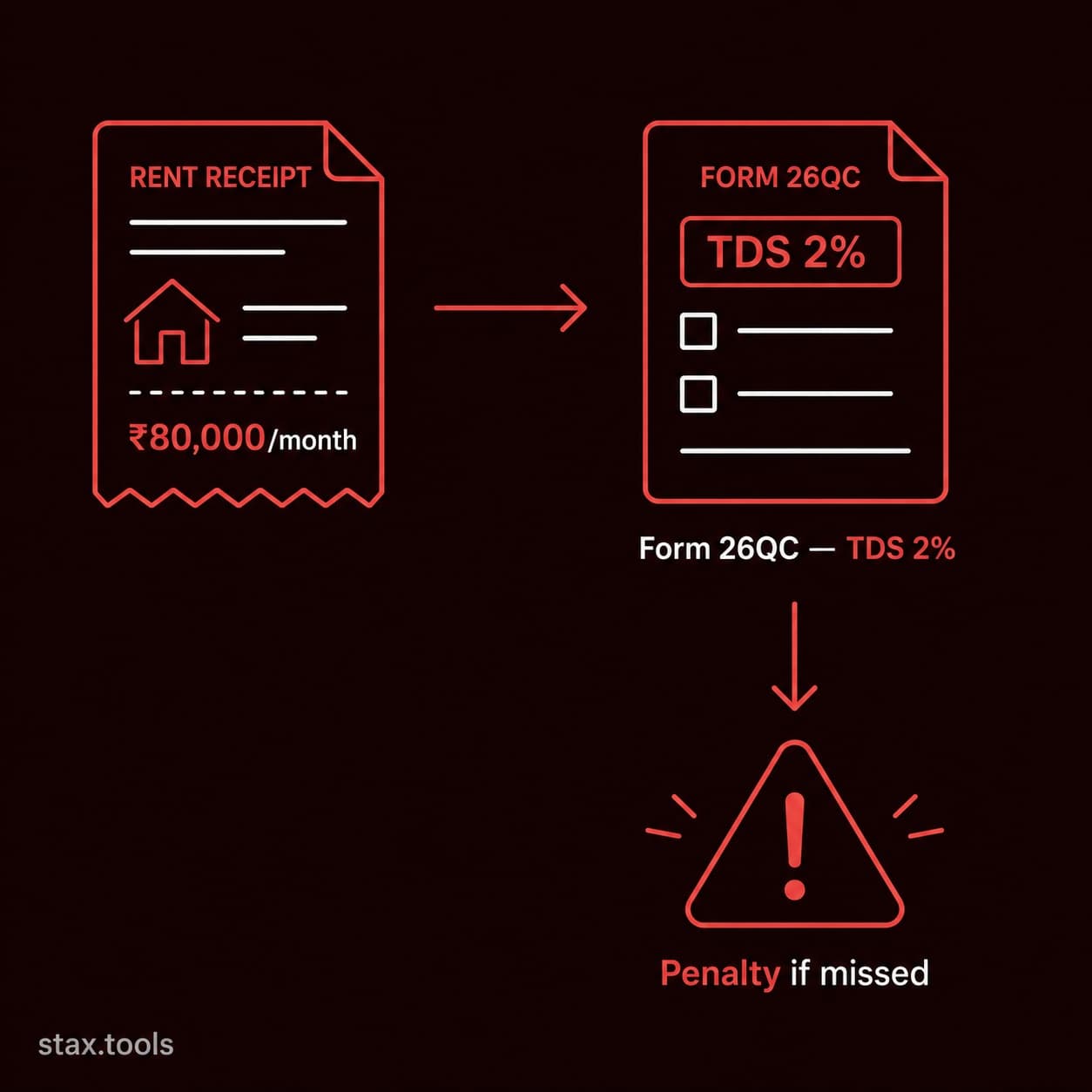
It is not. Under Section 194-IB of the Income Tax Act, 1961, the responsibility to deduct TDS on rent lies entirely with the tenant (individual or HUF) paying rent above ₹50,000 per month. The landlord's obligation is separate and applies only when they receive rental income. Most individual tenants are completely unaware of 194-IB because it was introduced only in June 2017 and awareness has been low.
Here is what you need to know and do.
Who must deduct TDS under Section 194-IB?
Section 194-IB applies when all of the following are true:
- You are an individual or HUF (Hindu Undivided Family) — not a company or firm
- You are paying rent for land, building, or furniture
- The monthly rent exceeds ₹50,000
- The rent is paid to a resident landlord (different rules apply for NRI landlords under 195)
If you are a company or firm paying rent, Section 194-I applies with a ₹2.4 lakh annual threshold (₹20,000/month) — a different provision with different filing requirements.
How much TDS must be deducted?
| Landlord type | TDS rate |
|---|---|
| Resident individual or HUF (with PAN) | 2% of rent |
| Resident individual or HUF (without PAN) | 20% of rent |
| Any landlord (if rent declared as business income) | 10% |
From FY2024–25, the TDS rate under 194-IB was revised from 5% to 2% (effective October 1, 2024 per Finance Bill 2024).
Example: Monthly rent of ₹80,000 to a landlord with a valid PAN.
- Annual rent: ₹9,60,000
- TDS to deduct: 2% of ₹9,60,000 = ₹19,200
- Timing: TDS is deducted only once — in the last month of the financial year (March), or in the last month of tenancy if you vacate before March
This once-a-year deduction is the unusual feature of 194-IB. Unlike other TDS provisions where deduction happens on each payment, 194-IB requires a single deduction in March (or at tenancy end).
When to deposit and how to file
Once you deduct TDS in March (or on the last month's rent before vacating), you must:
- Deposit the TDS to the government using Form 26QC — an online challan-cum-statement
- Deadline: Within 30 days from the end of the month in which TDS was deducted
- If you deduct in March 2026: deposit by April 30, 2026
- File on the Income Tax portal: itd.gov.in → e-Filing → TDS → Form 26QC
- Issue Form 16C to your landlord within 15 days of filing Form 26QC
No TAN (Tax Deduction Account Number) is required — Form 26QC uses your PAN instead. This was specifically designed to simplify compliance for individual tenants.
What happens if you don't comply?
| Non-compliance | Penalty |
|---|---|
| Failure to deduct TDS | Interest at 1% per month on the undeducted amount |
| Failure to deposit after deduction | Interest at 1.5% per month on the deducted amount |
| Late filing of Form 26QC | ₹200 per day (maximum total penalty = TDS amount) |
| Non-filing of Form 26QC | Penalty under Section 271H: ₹10,000 to ₹1,00,000 |
Beyond penalties, the landlord's PAN becomes non-compliant — their rental income may be flagged by the department as TDS not deposited, leading to demand notices for them as well. If the landlord discovers this, it creates tenancy friction.
Additionally, the tenant cannot claim the rent as a deduction (in business income scenarios) or in HRA calculations if TDS was not deducted as required. The Income Tax Department now matches Form 26AS and AIS data and flags cases where landlords report rental income but no corresponding TDS appears under their PAN.
The NRI landlord exception
If your landlord is an NRI (Non-Resident Indian) or a foreign entity, Section 194-IB does not apply. Instead, Section 195 requires TDS at 30% (plus surcharge and cess) on rent paid to NRIs, regardless of amount. This is a separate and more complex provision requiring a TAN and quarterly TDS returns. If your landlord is an NRI, consult a CA.
Practical steps for individual tenants
Step 1: Collect your landlord's PAN card copy (keep it on file)
Step 2: Calculate your total annual rent. If monthly rent × 12 exceeds ₹6,00,000 (i.e., monthly rent is above ₹50,000), you are covered by 194-IB
Step 3: In March (or your final month of tenancy), deduct 2% of the annual rent from that month's payment
- If annual rent is ₹8,40,000 → TDS = ₹16,800
- Pay the landlord ₹70,000 − ₹16,800 = ₹53,200 for March; ₹70,000 for all other months
Step 4: File Form 26QC online at incometax.gov.in within 30 days of March
Step 5: Issue Form 16C to landlord within 15 days of filing Form 26QC
Step 6: Keep Form 26QC challan and Form 16C copies for ITR documentation
Use the Stax TDS Calculator to compute the exact deduction amount and check applicable rates for different payment types.
Does this affect HRA exemption?
No — for salaried employees claiming HRA exemption under Section 10(13A), the TDS obligation under 194-IB is separate from the HRA submission to the employer. You still submit rent receipts and landlord PAN to your employer for HRA. The 194-IB TDS is an additional compliance step as a tenant, not a replacement for HRA procedures.
The landlord's side
For landlords receiving rent above ₹50,000/month from an individual tenant, the TDS obligation lies with the tenant. However, the landlord must:
- Provide their PAN to the tenant
- Account for the TDS in their ITR (the TDS credit appears in their Form 26AS after the tenant files Form 26QC)
- Report gross rental income (before TDS deduction) in their return
If TDS is not deducted by the tenant, the landlord is still responsible for paying advance tax on rental income. They should not assume the tenant has complied — check Form 26AS at the end of the year to confirm TDS credit.
By Grishma, personal finance writer at Stax Tools. TDS rates verified against Finance Act 2024 provisions effective October 1, 2024.
Sources & methodology
- Income Tax Act, 1961 — Section 194-IB (inserted by Finance Act, 2017)
- Finance Bill 2024 — Amendment to Section 194-IB TDS rate (2% effective Oct 1, 2024)
- CBDT Circular No. 08/2024 — Clarification on TDS under 194-IB
- Income Tax e-Filing portal — Form 26QC filing instructions, incometax.gov.in
Grishma
Finance Content Writer
Grishma writes about personal finance, investing, and tax planning for Indian readers — translating complex regulatory changes into clear, actionable guidance.
More by Grishma →Found this useful?
Browse 235+ free privacy-first tools — no login, no uploads, instant results.